
AI Adoption in Small Businesses: 2025 Trends, Benefits, and Strategies

Key Takeaways for AI Adoption in Small Businesses
The rise of AI adoption in small businesses is transforming how SMEs operate in 2025. Based on recent data, key insights include:
- Rapid Growth: 89% of small businesses use AI for automation, with U.S. adoption at 68%, up from 48% in 2024.
- Significant Benefits: Expect 29–72% productivity boosts and 20% revenue increases, with 85% anticipating returns.
- Key Challenges: Skill gaps (44%) and integration issues (37%) pose hurdles, though solutions are emerging.
- Bright Future: 78% of leaders see AI as a game-changer, with 80% planning chatbot use by year-end.
- Action Plan: Success hinges on piloting tools and managing risks like data privacy.

These insights highlight a pivotal opportunity, requiring strategic effort to maximize potential for AI adoption in small businesses.
In 2025, AI adoption in small businesses has become a transformative force, reshaping operations and innovation. Surveys show 89% of small businesses leverage AI for efficiency, with 58% of U.S. firms actively engaged—a jump from 48% in 2024. Globally, 88% of organizations, including many small ones, integrate AI into at least one function, though SMEs lag larger firms by 2–4x due to cost barriers. This surge is driven by accessible cloud tools, enabling even the smallest teams to adopt AI. Economically, it’s projected to add $15.7 trillion to the global economy by 2030.
This article explores trends, benefits, challenges, and strategies to guide small business owners.
Did you know? 89% of small businesses are embracing AI this year, but only 30% feel ready to scale.
The Boom in AI Adoption in Small Businesses
The landscape of AI adoption in small businesses is evolving rapidly, with AI tools gaining traction across industries. In the U.S., 68% of small businesses (up to 100 employees) use AI, up from 48% in mid-2024, with regional differences from 31% in West Virginia to 77% in Maine. Globally, 77% of small businesses have adopted AI in at least one area, with India leading at 59%. Even the smallest firms (1–4 employees) have seen adoption rise from 4.6% to 5.8% since 2023.
This growth is fueled by practical gains, including time and cost savings. Productivity gains enhance efficiency, while many users expanded their teams last year. Revenue increases through recommendations, and optimism is high, with many planning to boost investment.
| Region | AI Adoption Rate | Key Notes |
|---|---|---|
| U.S. | 68% | Up from 48% in 2024; varies by state (31% WV to 77% ME) |
| India | 59% | Leading global adoption |
| Global | 77% | At least one function; SMEs lag larger firms |
Did you know? U.S. adoption reached 68% in 2025, but regional gaps like 77% in Maine versus 31% in West Virginia highlight resource needs.
How AI Adoption in Small Businesses Drives Success
AI adoption in small businesses enhances operational success across key areas. In customer service, 47% use chatbots for 24/7 support, boosting retention by 20%, improving response quality by 95%, and speeding resolutions by 92%. In marketing, over 52% employ AI for content creation and ad targeting, with 47% enhancing conversions.
Other sectors benefit too. In inventory management, 36% use AI for demand forecasting, while 41% in finance automate invoicing and fraud detection. Recruitment sees 38% adoption for hiring support, and 46% use it in customer relationship management.
| Sector | AI Adoption Rate | Key Applications | Reported Benefits |
|---|---|---|---|
| Retail/E-commerce | 70% mission-critical | Personalization, inventory | 69% efficiency; 20% retention uplift |
| Marketing | 48–64% value AI | Ad targeting, content | 50%+ leads; 40–60% cost cuts |
| Customer Service | 80% for routine queries | Chatbots, support | 72% faster resolutions; 30% satisfaction |
| Energy/Manufacturing | Varies (high potential) | Automation, analytics | GDP-boosting profits |
| Healthcare/Tech | High agent adoption | Knowledge management | Innovation, satisfaction gains |
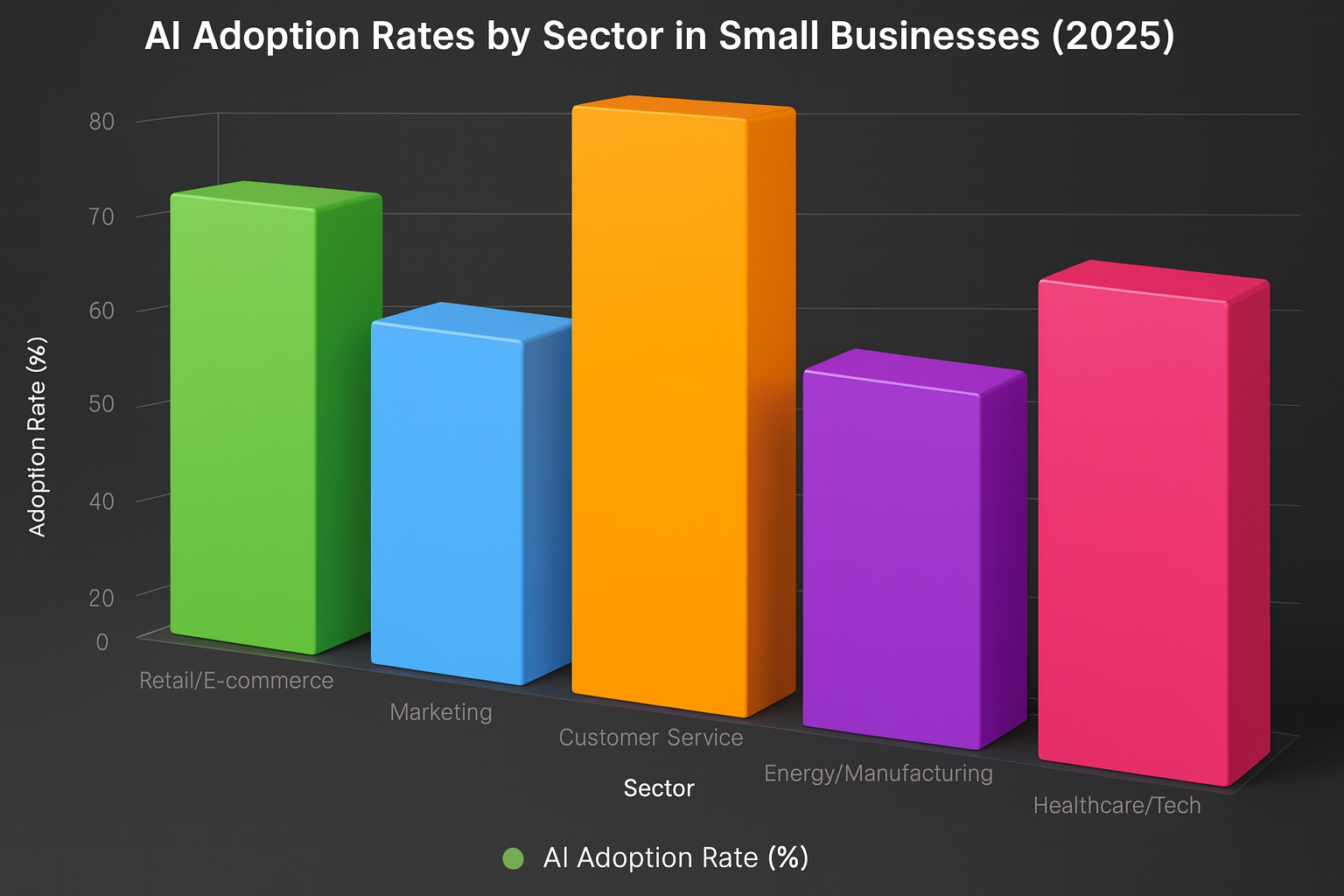
Did you know? 80% of customer service teams resolve queries 72% faster with AI.
Benefits of AI Adoption in Small Businesses
The benefits of AI adoption in small businesses are substantial. Cost savings of 40–60% in labor expenses, especially in call handling, free up budgets, while productivity soars 29–72%, allowing focus on high-value tasks. Revenue grows by 20% with personalized tools, and customer retention increases 30% with faster support. Additionally, 64% of firms credit AI with fostering innovation, and 50% report higher satisfaction.
High performers see EBIT gains up to 5%, reinforcing ROI potential. With 85% expecting returns and 78% of leaders viewing it as a competitive edge, the economic case is strong for AI adoption in small businesses.
| Benefit Metric | Percentage/Impact | Examples |
|---|---|---|
| Productivity Gains | 29–72% | Task automation |
| Cost Reductions | 40–60% | Call times, operations |
| Revenue Uplift | 20% | Conversion boosts |
| Customer Retention | 30% | Tailored support |
| Workforce Growth | 82% | Among adopters |
Did you know? 82% of firms expand their workforce with AI, driven by productivity gains of 29–72%.
Challenges Facing AI Adoption in Small Businesses
Despite its promise, AI adoption in small businesses faces obstacles. Funding limitations affect 22% due to tight budgets, while skill shortages impact 44%, with 20% of finance teams needing 60% upskilling in 2–5 years. Integration challenges hinder 37%, with only 30% ready to scale, and data governance issues (privacy, inaccuracy) affect 33%, leading to 51% experiencing setbacks.
Regulatory concerns worry 65%, with inconsistent state laws posing risks. Gartner predicts 30% of generative AI projects will be abandoned by year-end due to data quality and costs, with SMEs scaling at just 29% for AI adoption in small businesses.
| Challenge | Percentage Affected | Potential Impact |
|---|---|---|
| Skill Gaps | 20–44% | Upskilling needs, hiring barriers |
| Integration Issues | 30–37% | Limited scaling, project abandonment |
| Funding Limitations | 22% | High costs, delayed ROI |
| Data/Risk Issues | 51% | Privacy risks, inaccuracies |
| Regulatory Concerns | 65% | Growth impediments |
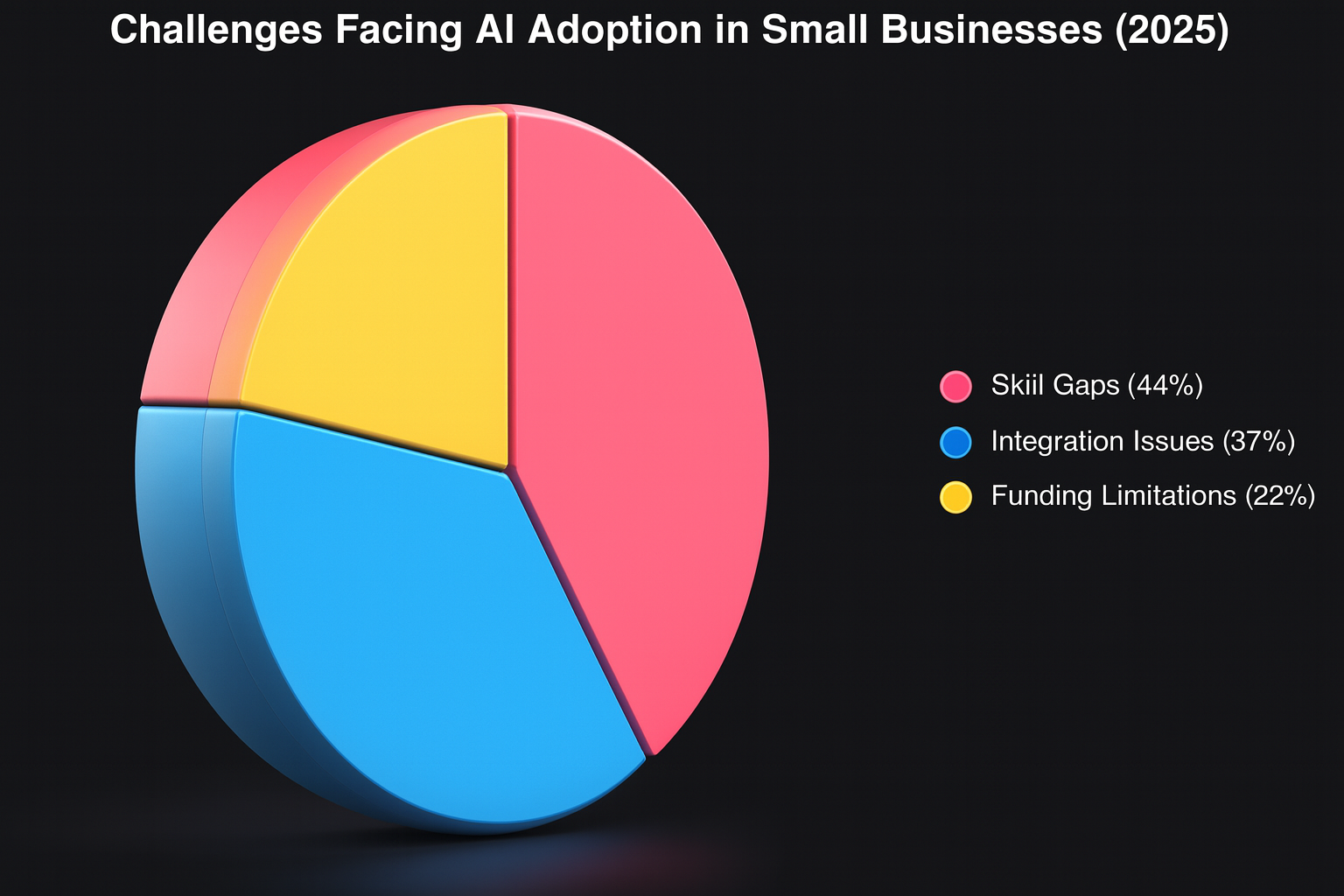
Did you know? 65% of small businesses worry about regulations, but compliance can boost trust and retention by 30%.
Solutions to Boost AI Adoption in Small Businesses
To overcome these hurdles, AI adoption in small businesses benefits from practical solutions. Low-code platforms like Zapier and Microsoft Power Automate empower non-technical users, while freelance ai business consultants offer expertise. Marketplaces like Google Cloud and AWS provide scalable tools, reducing costs. Upskilling through Coursera and Udemy has tripled enrollment, with AI skills increasing pay by 28%.
Government and educational support address skill gaps and infrastructure. For example, 40% of participants in chamber-led workshops integrated tools within months, halving setup time for AI adoption in small businesses.
| Solution | Impact | Examples |
|---|---|---|
| Low-Code Platforms | Empowers non-technical users | Zapier, Microsoft Power Automate |
| Freelance Consultants | Affordable expertise | Part-time AI guidance |
| Upskilling Programs | Tripled enrollment | Coursera, Udemy |
| Government Support | Halves setup time | Chamber workshops |
Did you know? Upskilling enrollment has tripled in 2025, with participants earning 28% more via platforms like Coursera.
The Future of AI Adoption in Small Businesses
The future of AI adoption in small businesses is promising with emerging technologies. AI agents for workflow automation are tested by 62%, scaled by 23%, and expected to replace traditional software in 15–20% of firms by year-end. Voice commerce, real-time analytics, and sustainability tools for carbon tracking are gaining traction.
Projections include 80% adopting chatbots by end-2025, an AI market reaching $407 billion by 2027, and 40% of work hours impacted by generative AI. While 32% anticipate minor cuts, high performers see growth in AI adoption in small businesses. Edge AI could enable rural firms to thrive.
| Projection Year | Key Metric | Value |
|---|---|---|
| 2025 End | AI Chatbot Integration | 80% |
| 2026 | Retail AI Spend | $20.05B |
| 2027 | Global AI Market | $407B |
| 2030 | Economic Contribution | $15.7T |
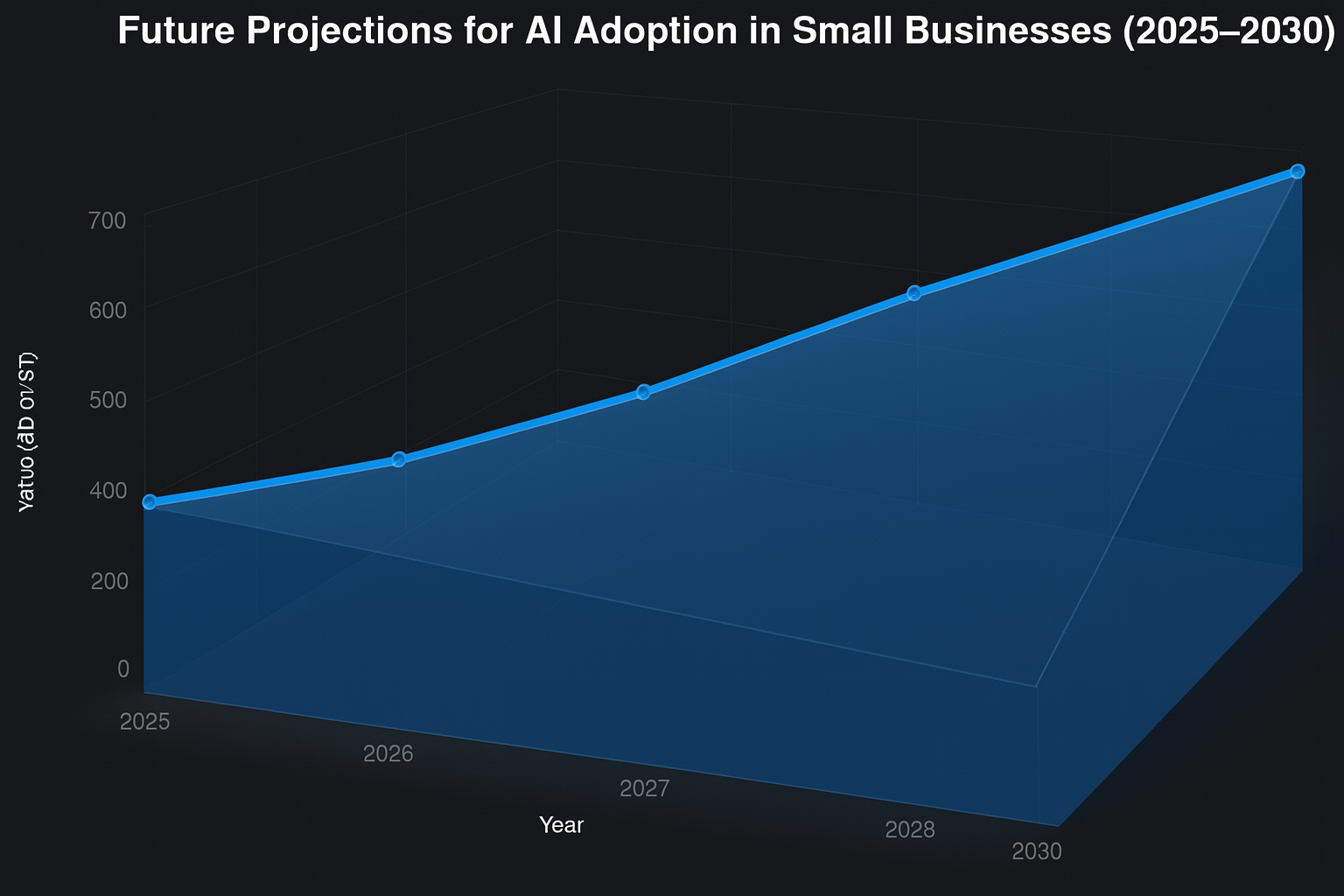
Did you know? AI could add $15.7 trillion to the economy by 2030, with 62% already testing agents.
Strategies to Enhance AI Adoption in Small Businesses
To thrive with AI adoption in small businesses, focus on ROI with quick wins like chatbots or marketing automation. Pilot small-scale projects to test effectiveness before scaling across departments. Choose interoperable tools integrating with existing systems. Balance human and AI roles by automating repetitive tasks, freeing staff for creativity.
A 5-step plan includes assessing needs, selecting tools like ChatGPT, training teams, monitoring results, and scaling gradually. With 78% of leaders viewing it as transformative, this approach ensures success for AI adoption in small businesses.
| Strategy Step | Action | Outcome |
|---|---|---|
| Assess Needs | Identify high-ROI areas | Targeted implementation |
| Select Tools | Choose interoperable options | Seamless integration |
| Train Teams | Use accessible programs | Skill enhancement |
| Monitor Results | Track metrics | Data-driven decisions |
| Scale Gradually | Expand successfully | Sustainable growth |
Did you know? 78% of leaders see AI as a game-changer, but piloting tools like Zapier can boost scaling success by 50%.
Conclusion on AI Adoption in Small Businesses
AI adoption in small businesses is vital for 2025 competitiveness, with adoption rates of 58–89% and productivity gains of 29–72%. Despite challenges, solutions like low-code platforms make it achievable. Start with a pilot to unlock growth and explore tailored tools.
FAQs on AI Adoption in Small Businesses
What is the Current State of AI Adoption in Small Businesses?
In 2025, AI adoption in small businesses is thriving, with 58–89% of U.S. and global firms using AI for marketing (52%) and customer service (47% with chatbots). This marks a rise from 25–48% in prior years, driven by cloud tools. U.S. adoption is 68%, up from 48% in 2024, while global rates hit 77%. However, very small businesses (1–4 employees) lag at 5.8%, and only 30% scale effectively.
How Does AI Adoption in Small Businesses Benefit Operations?
AI adoption in small businesses boosts productivity by 29–72% through automation of tasks like scheduling, saving 20+ hours weekly. Revenue increases 20% with personalized marketing, and costs drop 40–60%, saving $500–$2,000 monthly. Retention rises 30% with chatbots, and 64% report innovation. With 85% expecting ROI, piloting is key.
What Tools Support AI Adoption in Small Businesses?
For AI adoption in small businesses, tools like ChatGPT (62% experimenting) aid content creation, Jasper enhances marketing, and Grammarly Business improves team writing. Zoho Zia boosts CRM, Salesforce Einstein predicts sales, and QuickBooks AI automates finance. Zapier offers low-code workflows for 40% of users.
Is AI Adoption in Small Businesses Cost-Prohibitive?
No, AI adoption in small businesses is affordable in 2025, with tools like ChatGPT and Zapier starting at $0–$20/month. Despite 22% citing budget issues, savings of $500–$2,000 monthly yield 2x ROI. AWS and Google Cloud provide pay-as-you-go options, and 71% plan to boost budgets.
Can AI Adoption in Small Businesses Replace Workers?
AI adoption in small businesses enhances rather than replaces jobs, with 82% of adopters growing teams. While 32% predict 3%+ cuts from 29–72% productivity gains, AI handles 80% of routine queries, freeing staff for strategic roles. Upskilling (60% planned) supports this.
How to Measure ROI from AI Adoption in Small Businesses?
Measure ROI in AI adoption in small businesses by tracking productivity (29–72% gains), revenue (20% uplift), and cost savings (40–60%). Use baselines for tasks like invoicing via Zoho Zia dashboards, monitoring retention (30% boost) and leads (50%+). With 85% expecting returns, 3–6 month pilots guide success.
What Role Do Regulations Play in AI Adoption in Small Businesses?
Regulations influence AI adoption in small businesses, with 65% concerned about U.S. state laws on privacy. The EU AI Act’s low-risk category (e.g., chatbots) builds trust, boosting retention 30%. Using NIST guidelines, 51% reduce risks, doubling scaling speed.
How Can Small Businesses Begin AI Adoption?
Start AI adoption in small businesses by assessing high-ROI areas like customer service. Pilot tools like ChatGPT or Zapier for 3 months, training via Coursera (enrollment up 3x). Monitor 20% revenue gains, then scale with interoperable solutions.
Did you know? 85% expect ROI from AI, with 20% revenue gains turning tools into profit drivers.
An Article by N Delgado 2025 | CMO | AI Software Systems | AI Consultants For Business
Listen to the podcast on this article here:
Comments are closed.