
Parallel Processing: The Key to Affordable AI Agents for SMBs

Introduction
In 2026, small and medium-sized businesses are not just adopting AI — they are depending on it to compete. From automating customer support to streamlining inventory forecasting, AI agents for SMBs are quickly becoming the “virtual employees” that handle repetitive tasks without the overhead of hiring. For many SMBs, AI is now woven directly into their daily operations, shaping everything from marketing execution to financial analysis to frontline decision-making.
Yet despite this rapid growth, many business owners still ask the same question:
Why do some AI tools feel slow, inconsistent, or too expensive to scale?
The answer often has less to do with the AI model itself and far more to do with how the system processes tasks behind the scenes.
Most traditional AI tools process tasks one at a time — a bottleneck that limits speed and drives up costs. But modern, affordable AI agents designed for SMBs rely on a different approach: parallel processing, a computing method that allows multiple tasks to run at the same time. This shift is reshaping how companies build their AI strategy, design their AI adoption roadmap, and roll out AI onboarding programs for employees.
Parallel processing is the hidden engine that makes today’s AI agents faster, more capable, and genuinely affordable for small businesses. It turns AI from a slow, costly assistant into a high-performance digital worker — even for SMBs operating with tight budgets.
In this article, you will learn:
- What parallel processing means in everyday language
- Why parallel processing makes AI agents work faster and cheaper
- How parallel-enabled AI supports smarter automation, better decision-making, and real cost savings
- What this shift means for your company’s AI training for employees, internal AI readiness, and long-term adoption
By understanding this technology, SMB owners can make smarter choices about AI integration, build stronger digital workflows, and accelerate their transition from AI experimentation to fully operational AI-powered business systems.
Did you know that most AI tools still process tasks one at a time — even in 2026?
This is why many AI systems feel slow or expensive for SMBs. AI agents powered by parallel processing can complete multiple tasks at once, reducing both response time and compute costs. For many small businesses, this is the breakthrough that makes affordable AI agents finally practical.
What Parallel Processing Actually Means for AI

Did You Know: GPUs can deliver 3 to 10 times faster AI performance compared to CPUs for many common tasks because they handle parallel workloads more efficiently.
How Parallel Processing Makes AI Agents Affordable and Scalable for SMBs
Small businesses operate with tight budgets and limited IT staff. Parallel processing directly addresses these constraints in ways that matter to business owners.
1. Handles Complex, Multi‑Step Workflows Without Delays
Many real business tasks are made up of smaller steps. For example:
- Gather customer order history.
- Analyze buying patterns.
- Draft an email with personalized recommendations.
If an AI agent does these one by one, it can slow down. With parallel processing, different parts happen at the same time. Think of it as a team working together instead of one person handling everything.
Real SMB Example:
A retail shop uses an AI agent to monitor stock, predict demand, and reorder supplies. Instead of running these steps sequentially, the agent processes them in parallel. The result? A 40% reduction in stockouts and decisions made in near real time.
Fact: SMBs implementing AI systematically report an average ROI of $3.70 per $1 invested.
2. Enables Edge AI for Privacy and Low Latency
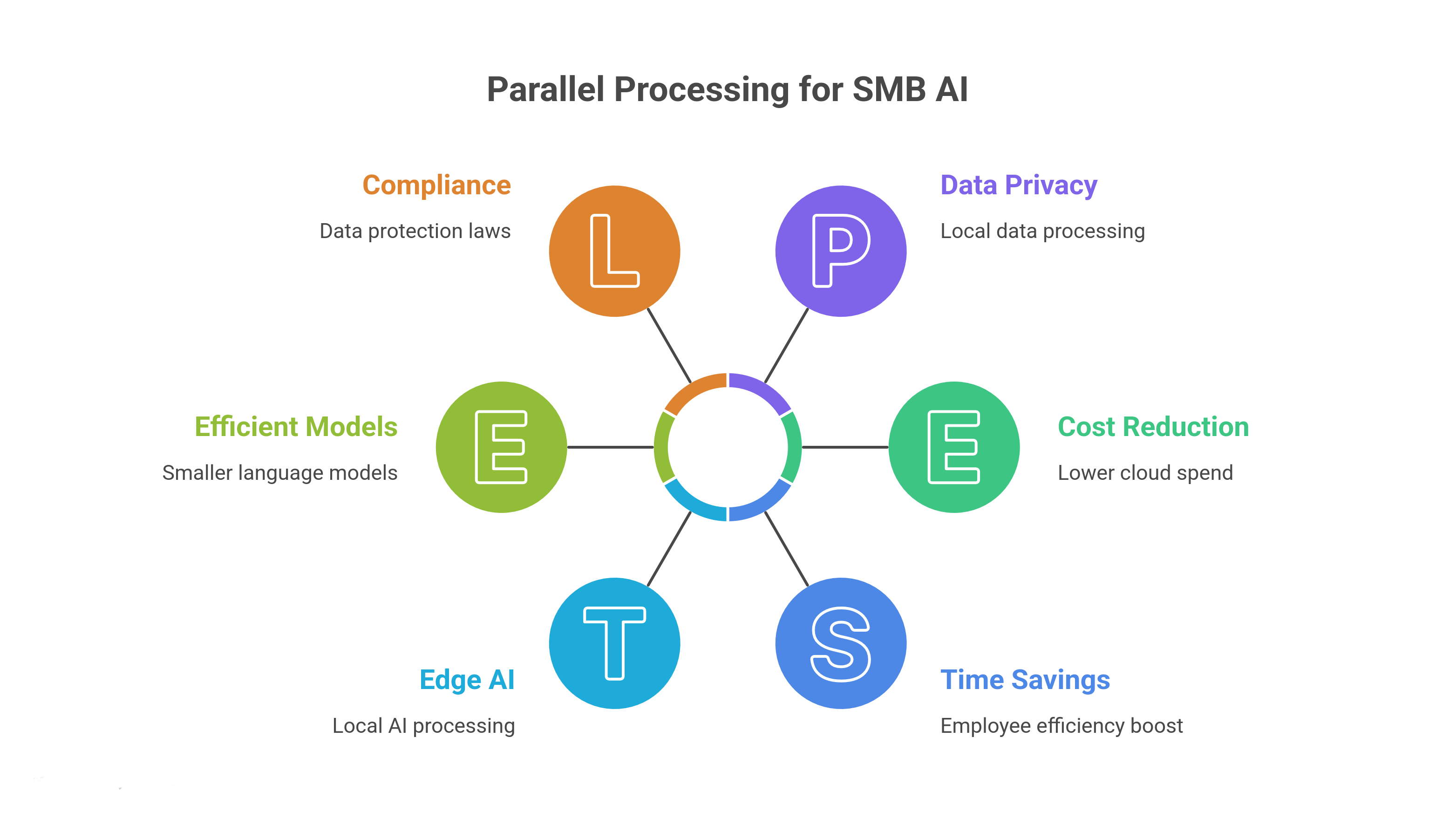
Not all AI needs to run in the cloud. Parallel processing can happen on local devices using hardware like modern CPUs with AI acceleration or compact GPUs in mini‑servers. This is called edge computing.
Running AI agents for SMBs locally has real advantages:
- Privacy: Sensitive customer data stays on your systems.
- Lower cloud spend: You avoid recurring cloud inference costs, which for many SMBs can be $500–$2,000 per month or more.
- Instant responses: For in‑store kiosks or localized systems, agents react in under a second.
Real SMB Example:
A Bay Area clinic processes appointment requests and triage data locally, keeping patient information private and compliant while delivering responses in under 1 second.
Fact: Employees in SMBs save an average 5.6 hours per week, and managers save 7.2 hours, using AI tools.
3. Scales Without Exploding Costs
Parallel processing lets you do more with less. Here’s how:
- Use efficient smaller language models that run faster in parallel rather than relying on large language models with high per‑use costs.
- Batch process items like customer requests together. Instead of 50 single calls, one batched request handles all in one go.
- Run multiple AI agents at once, such as support, marketing, and operations, without costs rising in proportion.
Fact: US SMB marketers save ~13 hours per week per person using AI and cut operational costs by ~$4,700/month per team.
Did You Know: Batching tasks for parallel execution often reduces cost per task compared to sequential processing.
Real‑World SMB Wins Powered by Parallel AI Agents
Customer Service
An agency used parallel AI agents for SMBs to handle incoming customer inquiries. One sub‑agent retrieved customer history, another checked the knowledge base, and a third drafted a response. The result was response times dropping from minutes to seconds and volume capacity tripling without hiring more staff.
Did You Know: Parallel task execution can increase throughput by more than 200% for customer service workflows.
Marketing & Content
A local e‑commerce brand used parallel workflows to research trends, generate copy, and optimize images. Instead of waiting on each step to finish, the brand’s parallel AI agents worked simultaneously. That led to personalized campaigns produced 5x faster and at a fraction of the manual cost.
Did You Know: Parallel processing accelerates creative workflows by distributing tasks across multiple AI engines.
Operations & Finance
In finance and ops, AI agents for SMBs can analyze invoices, check for discrepancies, and flag potential fraud all at once. A small firm using this setup saw error rates drop by 70% because problems were caught immediately instead of during a slow review process.
Did You Know: Parallel AI workflows reduce manual error by enabling cross‑checks in real time.
Why This Matters for Your Business Right Now
Parallel processing isn’t just tech talk — it is the difference between AI that is a nice experiment and AI that drives revenue. For SMBs, the benefits are clear:
- Cut operational drag: Free your team from repetitive tasks and let them focus on strategy.
- Compete like bigger players: Get enterprise-level speed and intelligence at a fraction of the cost.
- Future-proof your systems: As multi-modal and real-time AI becomes standard, a parallel foundation means you can scale without starting over.
Fact: 91% of SMBs with AI say it boosts revenue. 87% say it helps scale operations. 78% say it is a “game changer.”
In a landscape where efficiency is no longer optional, businesses that rely on traditional, linear automation risk being left behind. The parallel processing model supports real-time data evaluation, faster customer service, and intelligent decision-making — all at a cost that makes sense for growing companies.
Think of it as upgrading from a one-lane road to a multi-lane highway. Tasks that used to slow down your team or require multiple expensive software systems can now run side-by-side with minimal hardware investment. From faster inventory turnover to more responsive marketing, the competitive edge is tangible.
Even better, because parallel AI agents are modular, SMBs can scale one department at a time. Want to automate just support? Start there. Need to tackle accounting next month? Add an agent. This layered approach means small businesses can implement AI at a comfortable pace, with returns that fund future upgrades.
This adaptability makes parallel-powered AI agents not just an efficiency tool — but a long-term business strategy. It gives smaller companies the power to innovate faster, react to market shifts sooner, and run leaner operations without sacrificing quality or speed.
Fact: 91% of SMBs with AI say it boosts revenue. 87% say it helps scale operations. 78% say it is a “game changer.”
What Parallel Processing Means for the Future of the Internet
As parallel processing becomes a defining force behind modern AI, its influence is poised to extend far beyond hardware and cloud compute. Over the next decade, parallel processing will help reshape the backbone of the internet — shifting from a sequential, request-response model to a concurrent, distributed, AI-native infrastructure. This evolution will dramatically accelerate the development of affordable AI agents and transform how SMBs build their AI strategy and long-term digital operations.
From Single Streams to Parallel Pipelines
The current internet still operates largely as a single lane: one request goes in, one response comes out. But SMBs adopting AI expect faster automation, better decision-making, and more cost-efficient systems. As more companies begin building an AI adoption roadmap, the limitations of a sequential internet become clear.
Emerging technologies — from parallel inference engines to multi-agent orchestration — allow tasks to be split into dozens of parallel micro-processes. One query or workflow may activate many AI agents at once, each handling different parts of a job in real time.
For SMBs, this means:
- faster AI-powered decision support
- cheaper, more scalable AI agent development
- more efficient AI integration services
- AI systems that deliver enterprise-grade performance at small-business costs
Parallel processing doesn’t just make AI faster — it makes AI practical.
The Dawn of a PP-Native Internet (2028–2035)
A fully parallel-processing-native internet will emerge gradually, but the transition is already visible.
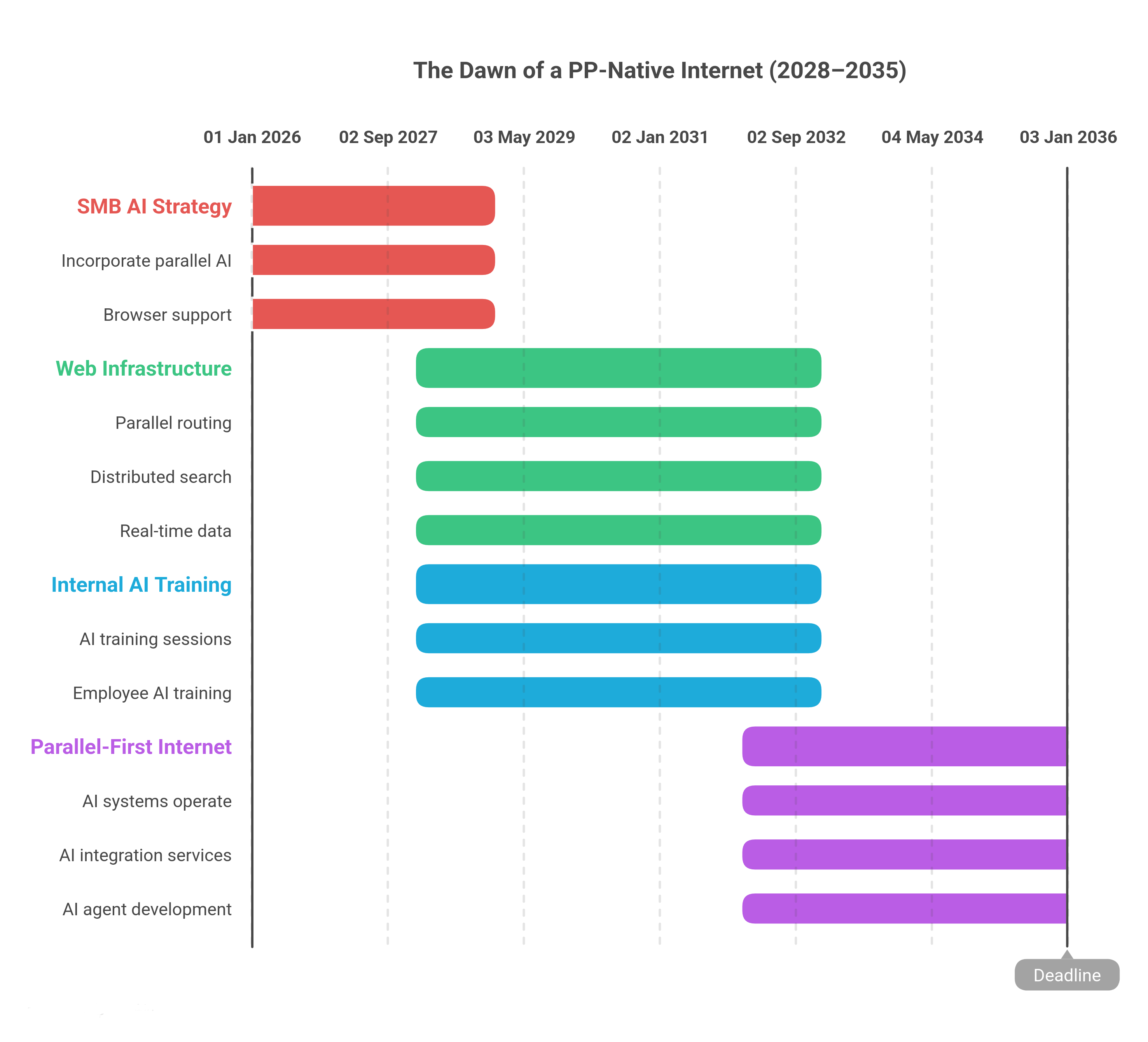
- 2026–2028:
SMBs begin incorporating parallel AI into their AI strategy, AI adoption roadmaps, and AI onboarding programs. Browsers and apps start supporting concurrent multi-agent workflows. - 2028–2032:
Web infrastructure evolves to handle parallel routing, distributed semantic search, and real-time data streaming. SMBs increasingly invest in internal AI training sessions and AI training for employees to prepare teams for new capabilities. - 2032–2035:
The internet becomes parallel-first, enabling AI systems to reason, route, and operate in real time. AI integration services and AI agent development become dramatically cheaper, faster, and easier to deploy across SMB operations.
What This Means for SMBs
For small and midsize businesses, a PP-native internet could be transformative. With parallel workflows vastly reducing compute costs and increasing performance, SMBs gain access to:
- cost-effective AI agents running parallel tasks
- scalable automation that supports every stage of growth
- AI-powered decision support that updates in real time
- lower infrastructure costs for AI integration services
- streamlined internal AI onboarding programs
- faster AI agent development cycles
- smoother employee adoption through better AI training programs
As parallel processing becomes a core layer of the internet, AI for SMBs will no longer be an innovation — it will be the operational standard. And businesses that begin preparing now, through the right AI strategy, employee AI training, and integrated AI adoption roadmap, will be positioned ahead of the curve.
Conclusion
The future of AI for small businesses hinges on performance, affordability, and usability. Parallel processing is not just a behind-the-scenes technical detail — it’s the core enabler of fast, cost-effective AI agents for SMBs that perform like enterprise-grade systems, but are accessible to SMBs. Whether you’re managing operations, marketing, or customer service, these systems can now respond in real time, scale with your needs, and save thousands in manual labor costs.
AI agents for SMBs powered by parallel processing aren’t a luxury reserved for tech giants. They’re already transforming how lean businesses operate, compete, and grow. By adopting this technology now, SMBs can leap ahead of slower competitors and build a future-ready foundation that pays dividends long term.
Frequently Asked Questions
What does “parallel processing” mean in simple terms?
Parallel processing means doing many tasks at the same time rather than one after another. For AI, it is like having many workers collaborate instead of a single person doing every step.
Can SMBs really afford GPU‑accelerated AI?
Yes. Cloud providers offer pay‑as‑you‑go GPU instances. In many situations, using efficient models with parallel processing is cheaper than traditional CPU‑only setups. You can also run models on affordable local hardware.
Do I need a tech team to set up these AI agents?
Not always. Many low‑code and no‑code platforms let you build parallel workflows. For more complex custom work, an AI consulting partner can guide the setup and integration.
What kinds of tasks are best for parallel AI agents?
Tasks that involve multiple steps or data sources are ideal — customer support routing, inventory forecasting, marketing content generation, and real‑time analytics are common examples.
How quickly can I expect ROI from these AI solutions?
Many SMBs see measurable impact within weeks of deployment — faster responses, reduced labor costs, and higher throughput are typical early wins.

An Article by N Delgado 2026 | CMO | AI Software Systems | AI Consultants For Business