

What Is Pi Agent?
So what is Pi Agent? Pi Agent aka Pi.dev is a minimalist, open-source AI coding agent that runs in the terminal and automates software development tasks with extreme simplicity and flexibility. Created by Mario Zechner, the mind behind the libGDX framework, Pi Agent stands out by using only four core tools—read, write, edit, and bash—while offering powerful extensibility through its TypeScript SDK.
For organizations exploring AI automation solutions for their business, Pi Agent represents an accessible way to integrate intelligent coding assistance without the bloat of commercial tools.
What Is Pi Agent and Why Was It Created?
Pi Agent, often referred to simply as “pi,” is a terminal-based coding harness designed to orchestrate large language models (LLMs) for practical software engineering work. Unlike feature-heavy agents that include sub-agents, complex planning modes, or excessive permissions, Pi keeps its core radically small: a short system prompt and a minimal toolset that prioritizes reliability and developer control.
Mario Zechner built Pi after growing frustrated with existing coding agents that felt like “spaceships with 80% unused functionality.” The result is a toolkit that lets users adapt the agent to their workflows rather than forcing rigid processes.
Did You Know: Pi Agent powers OpenClaw, an open-source AI agent platform that gained over 145,000 GitHub stars shortly after launch, showcasing how minimal design can drive massive adoption in the agentic AI space.
Core Architecture of Pi Agent
Pi consists of several interconnected packages in its monorepo:
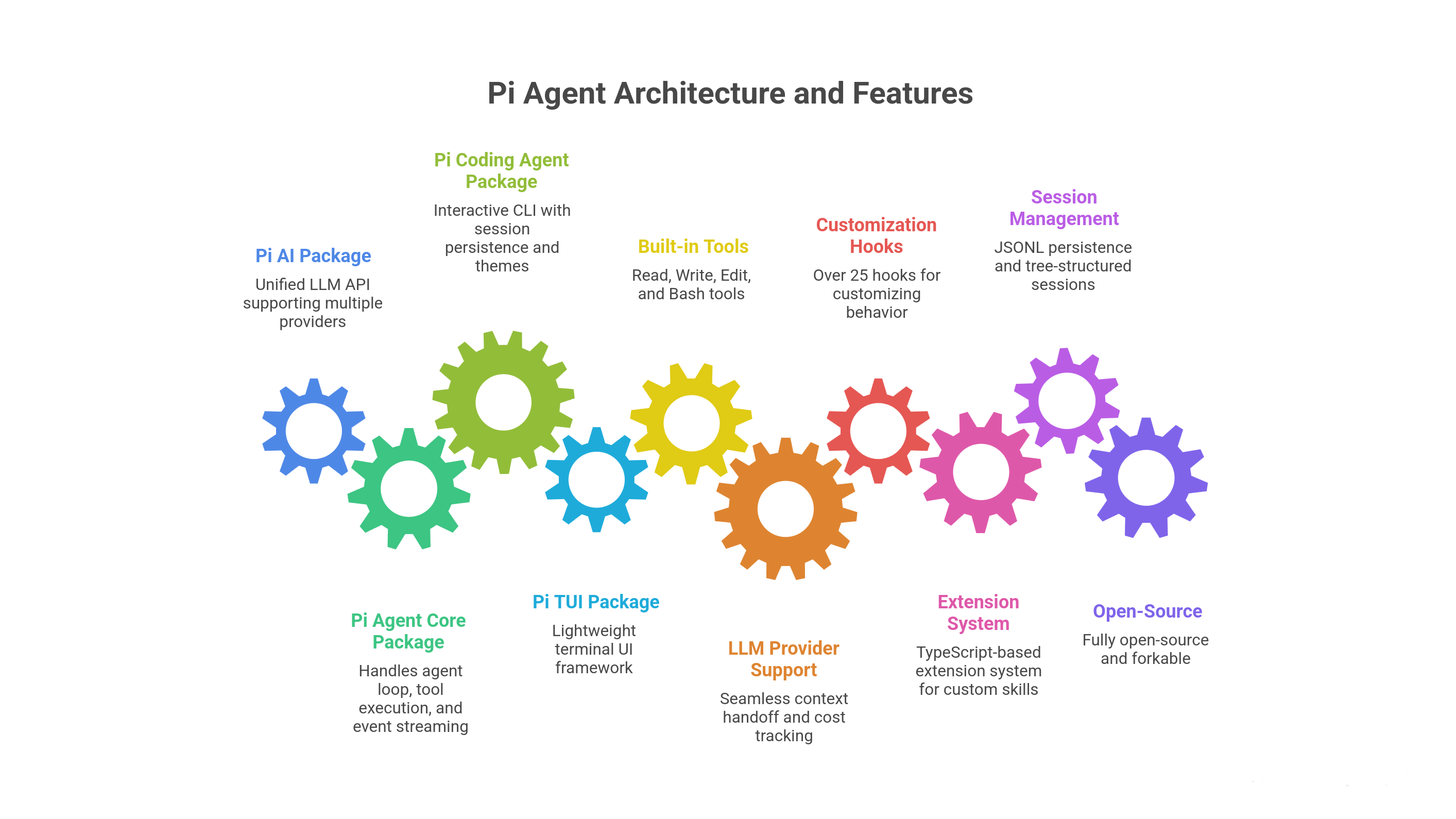
- pi-ai: A unified LLM API supporting providers like Anthropic, OpenAI, Google, xAI (Grok), Groq, and any OpenAI-compatible endpoint, with streaming, tool calling, and cost tracking.
- pi-agent-core: Handles the simple agent loop, tool execution, and event streaming.
- pi-coding-agent: The interactive CLI with session persistence, themes, and extensibility.
- pi-tui: A lightweight terminal UI framework for responsive, flicker-free interfaces.
This modular approach makes Pi suitable for both standalone use and embedding into larger systems.
Key Features That Set Pi Agent Apart
Pi Agent excels through deliberate minimalism combined with deep customizability:
- Only four built-in tools: Read (access files/context), Write (create code), Edit (modify files), and Bash (execute terminal commands).
- Support for 15+ LLM providers with seamless context handoff and token/cost tracking.
- Over 25 hooks for customizing behavior, themes, key bindings, and tool execution.
- Extension system using TypeScript, allowing hot-reloading of custom skills, prompt templates, and even sub-agents.
- Session management with JSONL persistence and tree-structured sessions.
- No lock-in: Fully open-source, forkable, and version-pinnable.
These features make Pi Agent particularly attractive for teams implementing AI-powered business automation, where control, transparency, and cost efficiency matter.
Did You Know: Pi’s short system prompt (one of the shortest among major agents) reduces token usage and helps maintain focus during long, complex coding sessions, often leading to fewer hallucinations compared to more verbose agents.
Benefits of Pi Agent for Developers and Businesses
Adopting Pi Agent delivers tangible advantages:
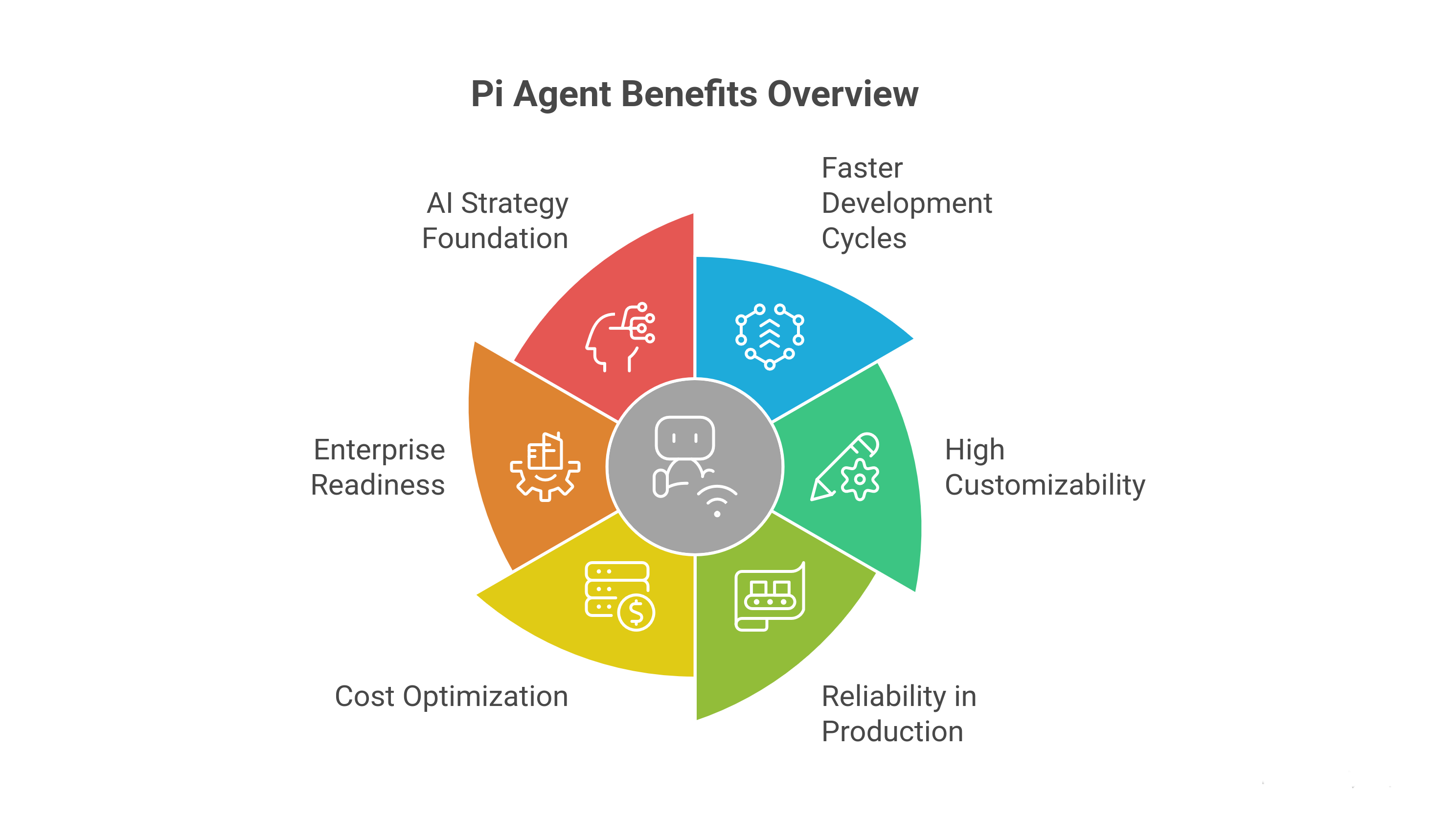
- Faster Development Cycles: The lightweight core enables quick iterations with lower overhead and API costs.
- High Customizability: Build exactly the agent you need using extensions and the SDK instead of fighting against opinionated frameworks.
- Reliability in Production Workflows: Simple agent loop reduces error compounding in multi-step tasks.
- Cost Optimization: Multi-provider support lets businesses choose the most economical LLM for each job.
- Enterprise Readiness: Embed Pi via the TypeScript SDK into internal tools, CI/CD pipelines, or custom platforms.
For AI strategy consultants and enterprise AI consulting engagements, Pi Agent serves as a foundation for building tailored automation that aligns precisely with business processes rather than forcing generic solutions.
Real-World Performance and Use Cases
Pi Agent has been used for rapid prototyping, large-scale code refactoring, debugging, and even powering complex platforms like OpenClaw. Developers praise its stability in long sessions, while businesses leverage it to accelerate internal tool development without vendor lock-in.
Did You Know: Pi Agent includes built-in support for creating “pi packages” — bundles of extensions, skills, and themes that can be shared via npm or Git, fostering a growing community ecosystem.
How to Get Started with Pi Agent
Installation is straightforward:
- Run
npm install -g @mariozechner/pi-coding-agent - Configure your preferred LLM provider by setting environment variables or using the built-in
/logincommand. - Navigate to your project directory and launch Pi with
pi. - Interact using natural language prompts, or extend it with custom skills and extensions for specialized workflows.
For programmatic use, the SDK allows embedding Pi into applications:
import { createAgentSession, ModelRegistry } from "@mariozechner/pi-coding-agent";Teams working with AI transformation consultants often rt here before scaling to full custom agent frameworks.
Did You Know: Pi supports headless RPC mode and JSON streaming, making it easy to integrate into web UIs, Slack bots (via pi-mom), or even VS Code extensions.
Pi Agent vs. Other AI Coding Agents
While tools like Claude Code, Cursor, or GitHub Copilot offer rich IDE integrations, Pi differentiates itself through minimalism and extensibility. It avoids sub-agents and plan modes by default but allows users to add them via extensions if needed.
This approach appeals to developers who want full control and to businesses seeking AI automation solutions for business that remain transparent and auditable.
For a deeper comparison or general custom implementation strategies, explore our guide on AI automation solutions for business.
Learn more about the philosophy behind Pi in Mario Zechner’s detailed blog post on building a minimal coding agent: shittycodingagent.ai.
FAQ
What is Pi Agent exactly?
Pi Agent is an open-source, terminal-based AI coding agent with a minimal core consisting of four tools and a short system prompt. It automates coding tasks while offering extensive customization through extensions and an SDK.
Who created Pi Agent?
Mario Zechner, creator of the popular libGDX game framework and a long-time open-source contributor, developed Pi Agent.
Is Pi Agent completely free?
Yes. The entire toolkit is MIT-licensed and available on GitHub. You only pay for the LLM API usage of your chosen provider.
How does Pi Agent compare to Claude Code?
Pi offers greater customizability and a leaner design with fewer built-in assumptions. Many users switch to Pi for its reliability in long sessions and ability to shape the agent exactly to their needs.
Can businesses use Pi Agent for enterprise projects?
Yes. Its SDK, multi-provider support, and extensibility make it ideal for enterprise AI consulting and building secure, cost-effective AI automation solutions for business.
Where can I find official documentation for Pi Agent?
Visit the official site at https://shittycodingagent.ai or the GitHub repository at https://github.com/badlogic/pi-mono for installation guides, API references, and community resources.
An Article by N Delgado 2026 | CMO | AI Software Systems | AI Consultants For Business