
Tools and Technologies in AI Consulting
Introduction
Artificial intelligence is no longer a futuristic idea—it’s here, and it’s changing how businesses operate every day. In fact, the global AI market is set to exceed $540 billion in 2025, with companies investing heavily to stay competitive. But simply “doing AI” isn’t enough. To make it work, organizations need the right tools and technologies in AI consulting to guide them from strategy to real-world results.
So, what does that mean? AI doesn’t run on magic—it runs on data platforms, model-building tools, automation systems, and monitoring frameworks. Together, these tools-technologies-in-AI-consulting help businesses clean up their data, build smart models, deploy them safely, and make sure they’re working as expected.
This is where AI consulting firms come in. They don’t just bring advice—they bring a proven stack of tools and methods that make AI work in the real world. Picking the wrong tools can lead to wasted money and failed projects. But with the right setup, companies can move faster, avoid costly mistakes, and get real value from AI.
In this guide, we’ll walk through the essential tools and technologies that every successful AI consulting project needs. Whether you’re just starting out or trying to scale, knowing the tools-technologies-in-AI-consulting landscape is the key to building smarter, more efficient systems that deliver real business impact.
Did You Know: Up to 85% of AI projects fail, mostly due to poor tool choices and weak data foundations (Gartner). But when the right tools are in place, companies are 4.5x more likely to see ROI within 12 months (McKinsey).
What Defines “Tools & Technologies in AI Consulting”
When we talk about tools and technologies in AI consulting, we’re really talking about the digital toolkit that helps companies solve big business problems using artificial intelligence. These tools guide everything—from preparing raw data to building smart models, deploying them into real-world environments, and making sure they perform well and ethically.
Think of it like building a house. You need blueprints (strategy), skilled workers (consultants), and the right tools (technology). Without the right tools, even the best plans can collapse. That’s why tools-technologies-in-AI-consulting are so important—they turn ideas into working AI systems.
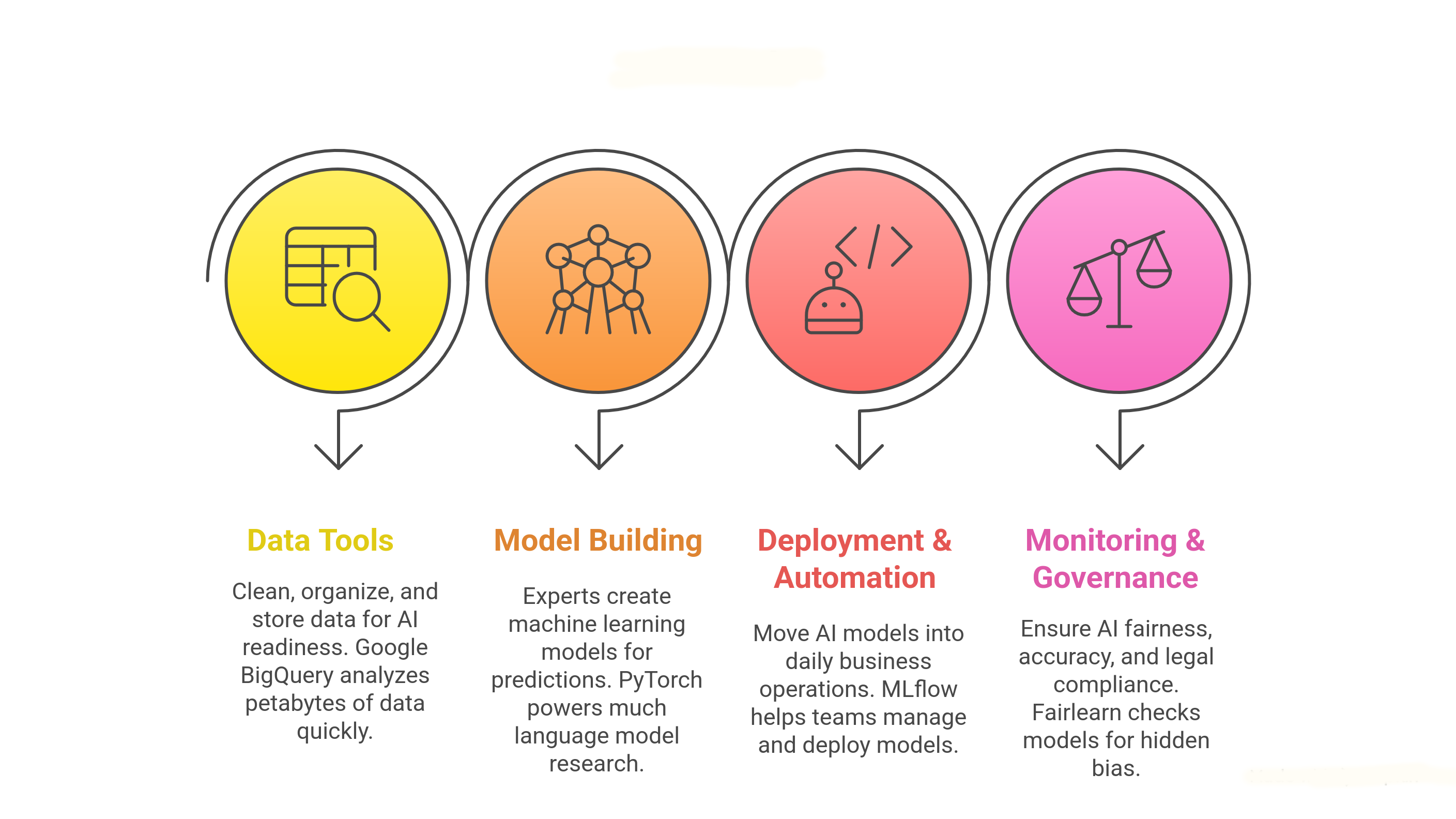
The Four Core Categories of AI Tools
-
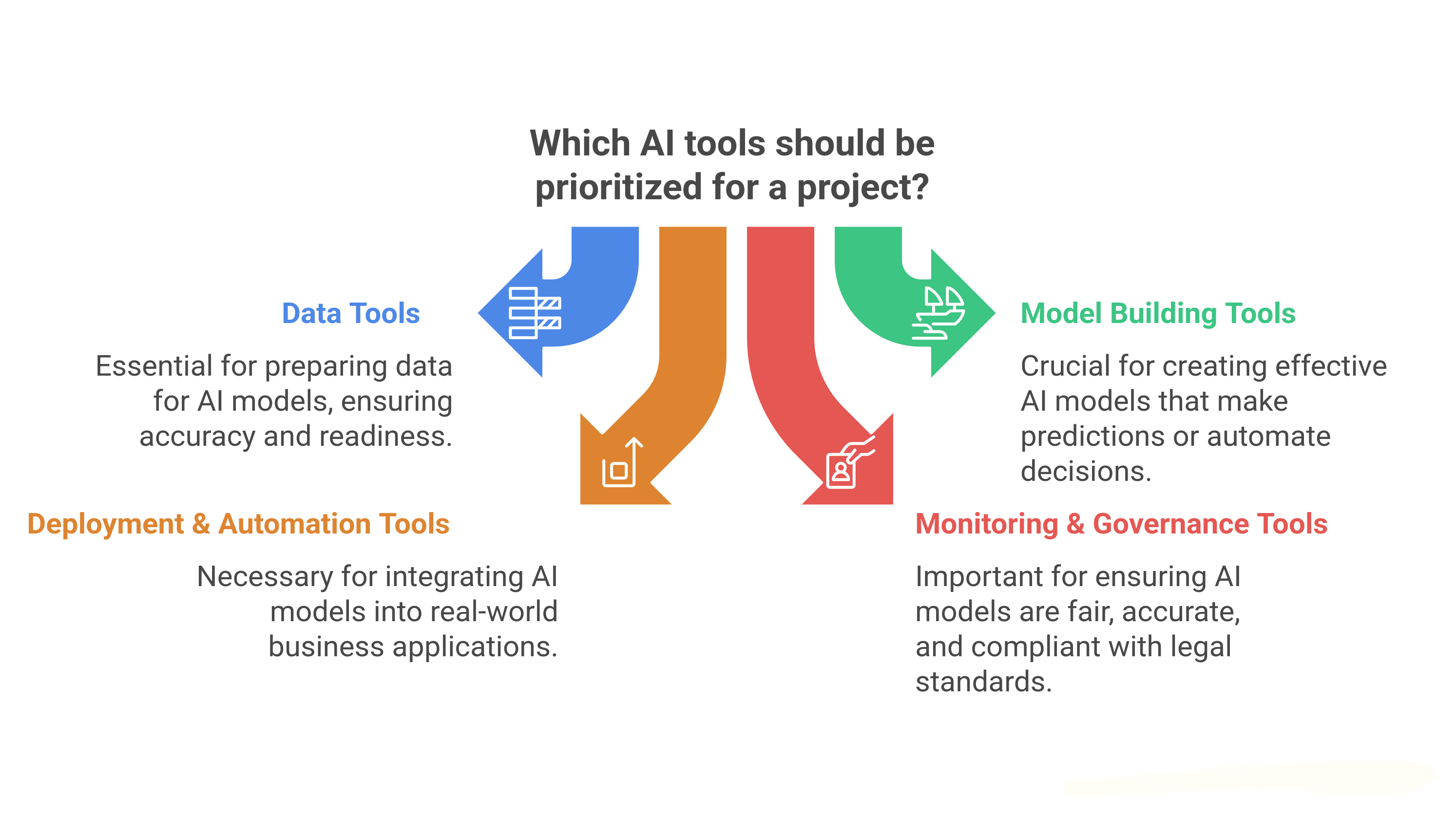
Data Tools
These help clean, organize, and store your data so it’s ready for AI.
Example: Google BigQuery can analyze petabytes of data in seconds. -
Model Building Tools
These let experts create machine learning models to make predictions or automate decisions.
Example: PyTorch powers over 50% of all large language model research today. -
Deployment & Automation Tools
These move AI models from a test environment into daily business use.
Example: MLflow helps teams track, manage, and deploy models consistently. -
Monitoring & Governance Tools
These make sure your AI stays fair, accurate, and legal.
Example: Fairlearn checks models for hidden bias in sensitive areas like gender or race.
Why These Tools Matter
-
Speed: Automating workflows can cut delivery time by 70%.
-
Accuracy: Better tools mean more precise AI predictions.
-
Risk Reduction: Good governance tools help companies avoid legal trouble.
-
Scalability: With the right setup, it’s easier to grow from a small test to a full company rollout.
How Consultants Use These Tools
Consultants typically split their time like this:
-
60%: Working with data (collecting, cleaning, organizing)
-
25%: Building and testing models
-
15%: Deploying, monitoring, and refining models
Did You Know: 85% of AI projects fail because of weak data foundations and poor tool choices (Gartner).
Data Infrastructure & Engineering
Every successful AI project starts with strong data. That’s why one of the most important parts of tools-technologies-in-AI-consulting is building solid data infrastructure. Without clean, organized, and accessible data, even the smartest AI models won’t work properly.
Consultants often spend the majority of their time helping businesses get their data ready. This includes collecting it from different sources, cleaning it up, and making sure it’s stored in the right format for AI tools to use. In fact, 60% of an AI project’s timeline is usually spent on data preparation.
Popular Data Tools in AI Consulting
- Storage Platforms: Snowflake, BigQuery, and Amazon S3 offer scalable cloud-based storage for structured and unstructured data.
- ETL/ELT Tools: Apache Airflow, Fivetran, and dbt help move and transform data so it’s usable by AI models.
- Data Quality & Reliability: Tools like Monte Carlo and Great Expectations ensure the data is accurate and complete before it’s used.
Best Practices
- Use data lakes to store raw, unstructured data from various sources.
- Use data warehouses for analytics and business intelligence workflows.
- Build real-time data pipelines for industries like finance and retail, where speed matters.
- Track data lineage to ensure transparency, especially in regulated industries.
- Treat data pipelines like code—version them, test them, and monitor performance continuously.
Did You Know: Companies with mature data infrastructure are 4.5 times more likely to see measurable AI ROI within the first year. Without it, most AI models never make it to production.
Machine Learning, Deep Learning & Generative AI
At the heart of every AI project are the models—the systems that learn from data and make predictions or decisions. This is where tools-technologies-in-AI-consulting really shine. Consultants use a wide variety of model-building tools to train everything from simple classifiers to advanced generative AI systems.
These tools help AI consultants match the right kind of model to each business problem. Whether it’s predicting customer churn, detecting fraud, or summarizing legal documents, there’s a model—and a tool—for that.
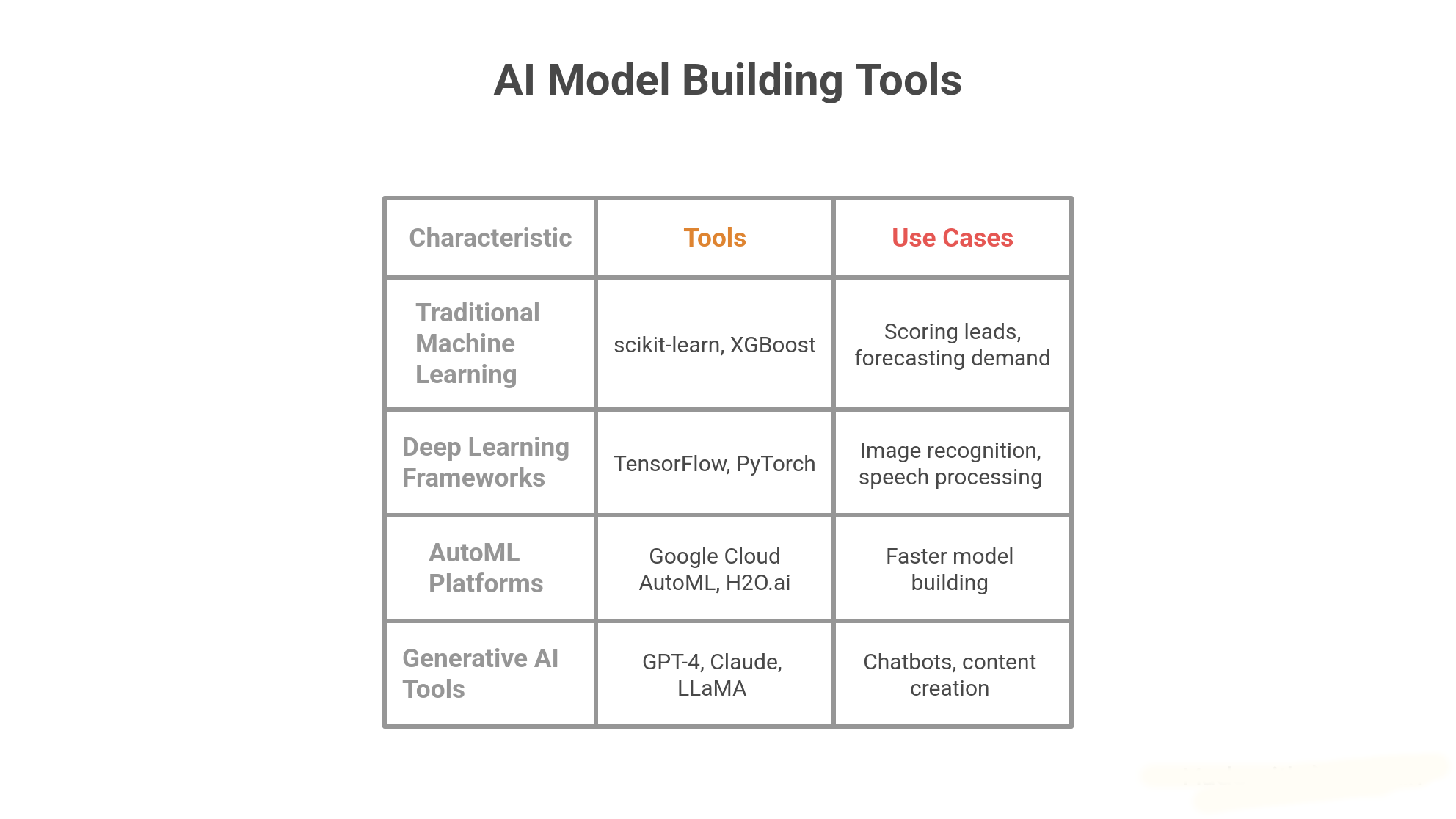
Common Tools for Building AI Models
- Traditional Machine Learning: scikit-learn and XGBoost are great for structured data tasks like scoring leads or forecasting demand.
- Deep Learning Frameworks: TensorFlow and PyTorch are used for complex tasks like image recognition, speech processing, and natural language understanding.
- AutoML Platforms: Tools like Google Cloud AutoML and H2O.ai allow teams to build models faster, without deep coding experience.
- Generative AI Tools: GPT-4 by OpenAI, Claude by Anthropic, and Meta’s LLaMA power advanced use cases like chatbots, content creation, and virtual agents.
Real-World Use Cases
- Telecom: Predicting which customers are likely to cancel their service
- Finance: Detecting unusual patterns that may indicate fraud
- Legal: Using large language models to summarize and tag long contracts
- Retail & Marketing: Generating product descriptions or campaign copy with generative AI
Did You Know: As of 2025, 71% of companies are using generative AI in at least one department—but only 27% are using it across the business. Tools make the difference between experimentation and scale.
AI Agents, Chatbots & Conversational Interfaces
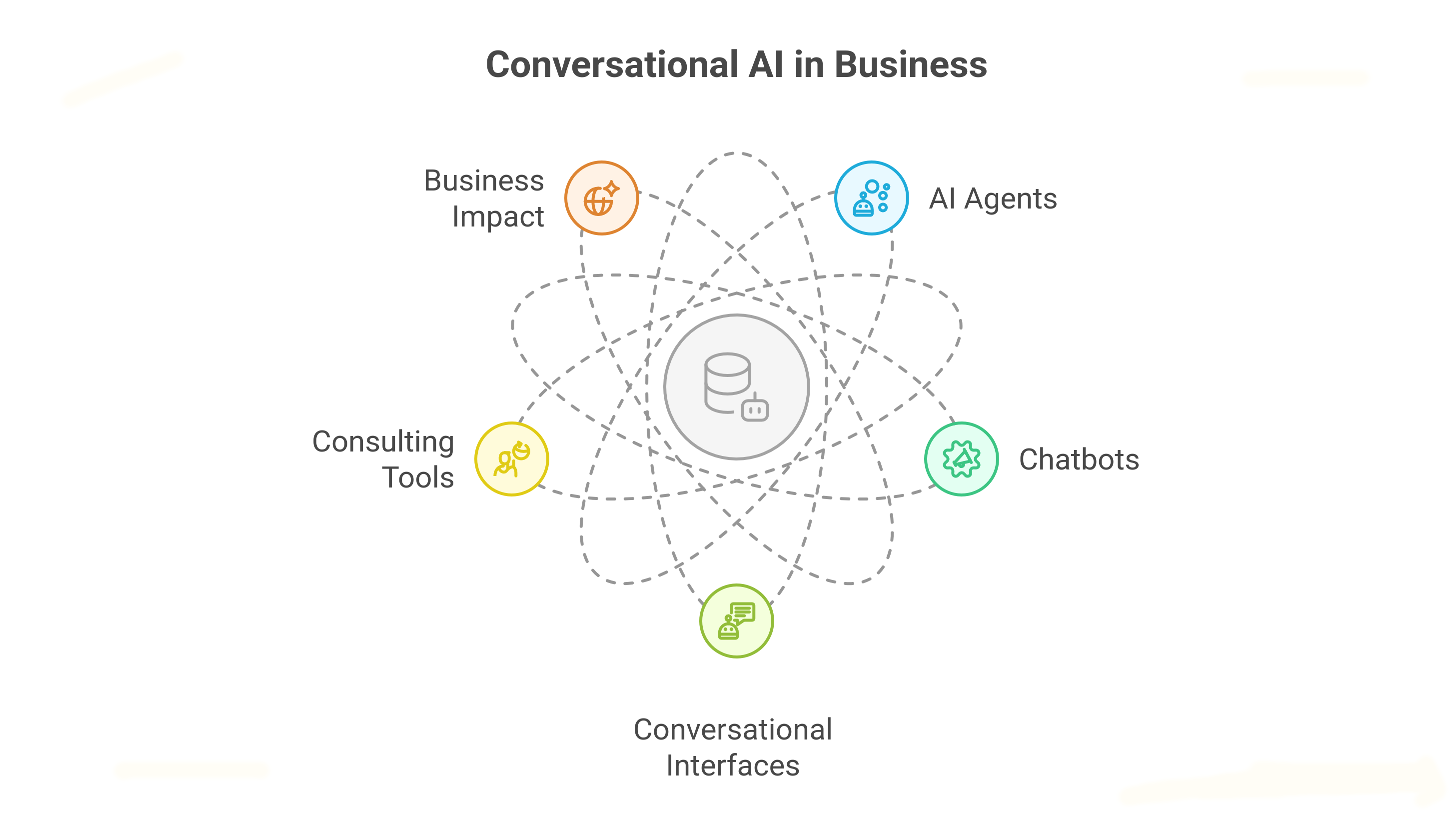
One of the most visible—and useful—applications of AI is conversation. Whether it’s a chatbot on a website or a virtual assistant helping employees,tools-technologies-in-AI-consulting include powerful platforms that bring AI into human dialogue.
Consultants use these tools to help companies automate repetitive questions, streamline support, and even coordinate complex tasks across departments. The beauty of conversational AI is that it’s easy for users to interact with—no training required. Just ask, and the AI responds.
Types of AI Agents in Consulting Projects
- Knowledge Assistants: Help employees find documents, data, and insights faster.
- Customer Service Chatbots: Answer FAQs, schedule appointments, and provide product support.
- Multi-Agent Systems: Coordinate actions between different bots or systems, like order processing + inventory updates.
Tools & Platforms Consultants Use
- LangChain: Used to build powerful agents using large language models like GPT-4.
- Rasa: Open-source framework for building custom conversational experiences.
- Dialogflow: Google’s conversational AI platform for deploying scalable chatbots.
- Cognigy: Enterprise-grade platform with built-in integration tools and automation features.
Impact on Business
- 30% of all enterprise support tasks are now handled by AI agents.
- Companies that use conversational AI report up to 40% savings in customer service costs.
- Internal AI assistants can cut time spent searching for information by more than half.
Did You Know: Businesses that embed AI agents into core workflows report twice the customer satisfaction compared to those relying only on traditional support channels.
Process Automation & RPA
Not every task needs deep learning or complex models. In fact, many of the biggest wins in AI consulting come from automating simple, repetitive processes. That’s where process automation and robotic process automation (RPA) come in—a key part of tools-technologies-in-AI-consulting that often delivers fast, measurable results.
Consultants use RPA tools to mimic human actions: clicking, copying, pasting, validating forms, and moving data between systems. When combined with AI, these automations become smarter—able to understand documents, extract data, and even make decisions.
Key Tools Used in AI Automation Projects
- RPA Platforms: UiPath, Automation Anywhere, Blue Prism—ideal for automating tasks in finance, HR, supply chain, and more.
- Intelligent Document Processing (IDP): ABBYY, Kofax, and Hyperscience can read invoices, contracts, and forms using AI.
- Integration with AI Models: Many consultants link RPA bots to ML models for decision-making or error detection.
Real Use Cases
- Invoice Processing: Automating the entire workflow from data capture to approval
- Claims Handling: Speeding up insurance claims using document understanding
- Employee Onboarding: Automating setup of accounts, payroll, and training sequences
- Supply Chain Automation: Coordinating shipments, inventory updates, and alerts
Did You Know: For every $1 invested in intelligent automation, companies save between $3 and $5, making it one of the highest-ROI use cases in AI consulting (Deloitte).
Deployment, Monitoring & MLOps
Building an AI model is just the beginning. The real challenge? Getting it into production—and keeping it there. That’s why deployment, monitoring, and MLOps are crucial elements of tools-technologies-in-AI-consulting.
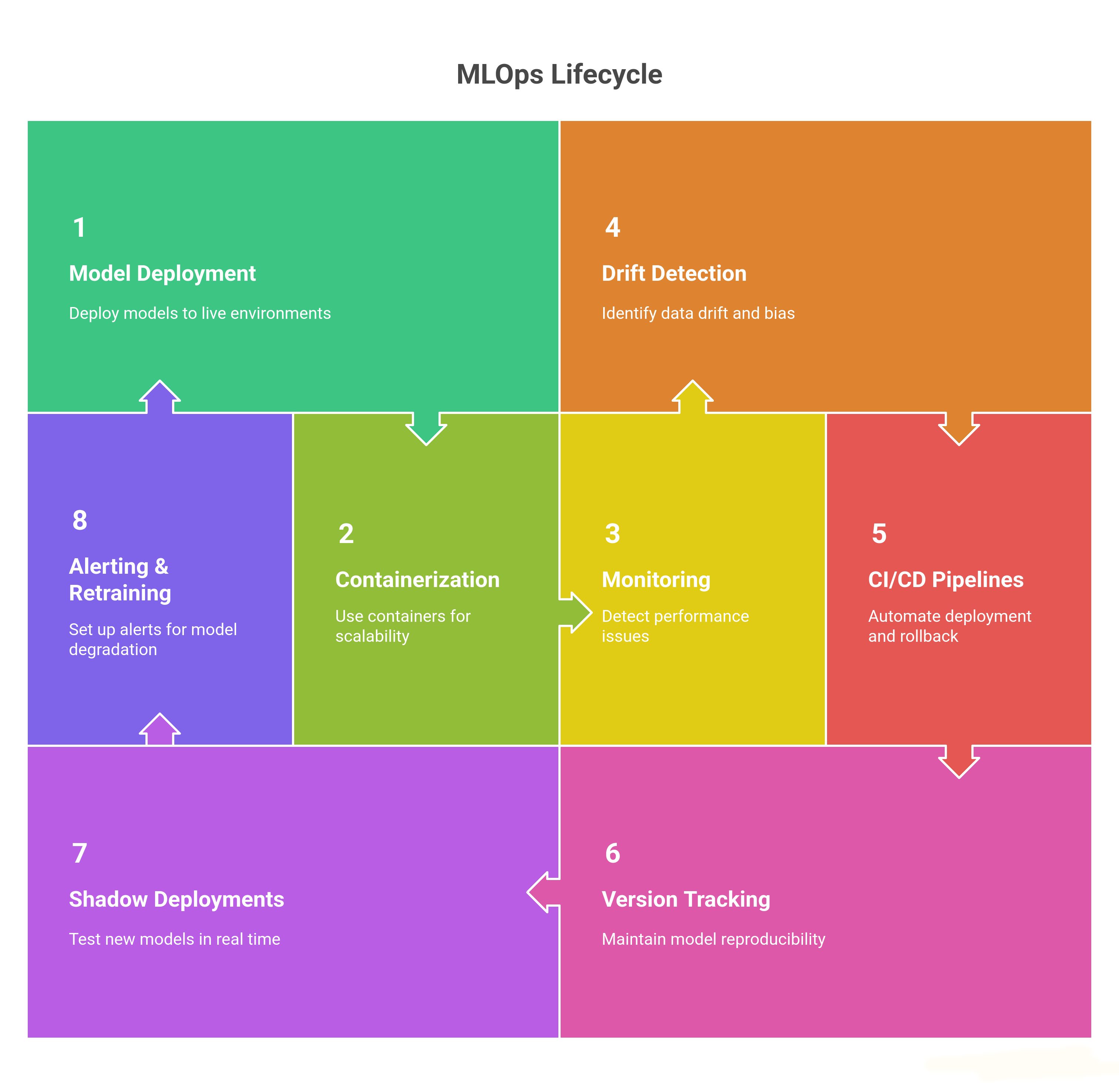
MLOps (short for Machine Learning Operations) is the practice of managing the entire AI lifecycle—from training and testing to deployment and ongoing monitoring. It’s like DevOps, but for AI. These tools help consultants make sure that AI systems run reliably, update when needed, and stay aligned with business goals.
Core Tools in MLOps & Deployment
- Model Deployment: MLflow, Amazon SageMaker, and Azure ML help push models into live environments with speed and consistency.
- Containerization: Docker and Kubernetes let companies deploy models in scalable, cloud-ready environments.
- Monitoring & Drift Detection: WhyLabs, Evidently AI, and Arize AI watch over models to detect performance issues, bias, or data drift.
Best Practices Consultants Follow
- Use CI/CD pipelines to automate model deployment and rollback if needed.
- Track every model version to maintain reproducibility and transparency.
- Run shadow deployments to test new models alongside old ones in real time.
- Set up alerts and automatic retraining for when models begin to degrade.
Why It Matters
- Without MLOps, most models never make it to production or become unreliable over time.
- With a solid MLOps setup, teams can deploy models 12 times more often and fix issues faster.
- MLOps ensures that the performance you saw during testing actually holds up in the real world.
Did You Know: According to McKinsey, companies with strong MLOps pipelines deploy AI at scale significantly faster—and see ROI in months, not years.
Analytics, BI & Visualization
AI models generate tons of valuable insights—but if those insights aren’t presented clearly, they often go unused. That’s why analytics, business intelligence (BI), and data visualization tools are a crucial part of tools-technologies-in-AI-consulting.
These tools help bridge the gap between complex AI systems and everyday business users. With the right dashboards and visual reports, decision-makers can quickly understand what the AI is doing, how well it’s performing, and what actions to take next.
Tools Consultants Use for Visualization
- Power BI: Microsoft’s user-friendly platform for building interactive dashboards and reports.
- Tableau: Widely used for deep visual exploration and storytelling with data.
- Looker: Great for embedding insights directly into workflows and apps.
- Qlik: Offers powerful associative analytics for digging into patterns.
- Celonis: Used for process mining—helping consultants analyze and optimize workflows before and after AI implementation.
Key Use Cases
- Executive Dashboards: Visualizing KPIs and AI performance for leadership teams.
- Model Monitoring: Tracking prediction accuracy, confidence intervals, and drift over time.
- Operational Reporting: Showing frontline teams how AI is improving efficiency or customer outcomes.
Why This Matters
- Makes AI more transparent and usable across teams
- Helps catch issues early, before they become bigger problems
- Builds trust by showing clear evidence of AI value
Did You Know: Companies that combine strong BI tools with AI report a 2–4x higher return on their AI investments compared to those without clear reporting frameworks.
Governance, Ethics & Compliance
Getting AI into production is a major win—but keeping it responsible, legal, and trustworthy is just as important. That’s why governance, ethics, and compliance are a core part of modern tools-technologies-in-AI-consulting.
AI governance tools help businesses track how decisions are made, ensure fairness, and stay on the right side of the law. This is especially important in industries like finance, healthcare, and government, where the impact of AI decisions can be significant.
Tools for Trustworthy AI
- Bias & Fairness Testing: Tools like Fairlearn and AIF360 identify unfair treatment based on sensitive traits like gender or race.
- Explainability Platforms: SHAP, LIME, and Fiddler AI help make complex models more understandable and defensible.
- Compliance Monitoring: WhyLabs and Arize AI log predictions and provide audit trails to ensure compliance and traceability.
Compliance Standards That Matter
While EU laws like the AI Act may not apply to your region, there are still important frameworks to follow:
- CCPA (California Consumer Privacy Act) – applies if your business interacts with U.S.-based consumers
- HIPAA – applies to AI systems handling health data in the U.S.
- NIST AI Risk Management Framework – widely used for responsible AI design in North America
- Internal Governance Policies – consultants often help create customized frameworks based on business needs
Consultant Responsibilities
- Run bias audits before deployment
- Use tools that provide explainable AI outputs
- Limit access to AI models through secure roles and permissions
- Keep detailed logs of decisions and data flows
Why It Matters
- Protects your company from legal and PR risks
- Increases customer and stakeholder trust
- Supports long-term AI adoption and funding
Did You Know: In North America, over 60% of executives say they won’t scale AI without clear governance policies in place. Governance is no longer optional—it’s expected.
FAQs
What are the must-have tools for a new AI consulting firm?
A solid starting toolkit for AI consulting should include:
- Airflow or dbt for data pipeline orchestration
- PyTorch or TensorFlow for model development
- MLflow for model tracking and deployment
- Power BI or Tableau for visualizing outcomes
- Access to APIs like GPT-4 for generative AI use cases
These tools form the foundation of effective tools-technologies-in-AI-consulting workflows.
How do AI tools vary across different industries?
The right tools-technologies-in-AI-consulting depend on your domain:
- Finance requires auditability and explainability (e.g., SHAP, Fairlearn)
- Retail benefits from real-time analytics (e.g., Looker, Snowflake)
- Healthcare must comply with strict data governance (e.g., HIPAA, secure storage)
- E-commerce often uses conversational agents and recommendation systems
Tailoring your toolset to the industry’s priorities is key.
What are the biggest deployment challenges consultants face?
Common hurdles include:
- Integrating with legacy systems
- Lack of MLOps infrastructure for model versioning and automation
- Gaps in monitoring and drift detection
- Compliance friction, especially in regulated sectors
- Stakeholder resistance or lack of technical readiness
Overcoming these requires careful selection and implementation of tools-technologies-in-AI-consulting.
How can fairness and transparency be ensured in AI systems?
Consultants use tools like Fairlearn, AIF360, and SHAP to:
- Test for bias across sensitive features
- Explain how models make predictions
- Provide audit trails for compliance reviews
Building trust is a major part of any ethical tools-technologies-in-AI-consulting project.
Can generative AI replace traditional machine learning models?
Not entirely. Generative AI is great for content creation, summaries, and natural language tasks. But traditional ML models still outperform in:
- Predicting structured outcomes (e.g., churn, fraud)
- Handling tabular data efficiently
- Providing more control in regulated environments
Both play a role in a well-rounded tools-technologies-in-AI-consulting strategy.
Did You Know: 89% of AI leaders say consultants are essential for proper tool selection.
Conclusion
AI is transforming the way businesses operate—but success doesn’t come from AI alone. It comes from using the right tools and technologies in AI consulting to turn ideas into impact. From collecting data to building models, deploying them, and ensuring they’re fair and compliant, every step depends on the tools you choose.
Smart AI consulting firms don’t just follow trends—they align tools with business goals, industry needs, and operational realities. Whether it’s picking the right automation platform, designing scalable MLOps pipelines, or ensuring governance, the real value lies in creating systems that deliver long-term results.
And while AI itself continues to evolve rapidly, one thing remains constant: choosing the right tools-technologies-in-AI-consulting is a strategic decision, not just a technical one. Companies that understand this are faster to market, more resilient to risk, and better positioned to lead in the age of AI.
Because in the end, tools don’t make change happen—people do. But in the right hands, the right tools unlock the full power of artificial intelligence.
An Article by N Delgado 2025 | CMO | AI Software Systems | AI Consultants For Business