

NanoClaw vs OpenClaw: The Secure, Lightweight AI Agent Alternative
Think of AI agents as your tireless digital employees—they handle repetitive tasks, connect apps, send messages, and make decisions without constant supervision. As companies dive into AI business consulting and AI strategy consulting, these “digital employees” are revolutionizing automation, digital transformation, and efficiency.
Today, one of the hottest comparisons in the AI world is NanoClaw vs OpenClaw.
OpenClaw burst onto the scene like a Swiss Army knife: packed with features to build powerful AI agents that interact with tools, APIs, email, Slack, WhatsApp, and more. It’s popular because it can tackle complex workflows and save huge amounts of manual work.
But like a big, feature-loaded toolbox, OpenClaw can become heavy and risky—too many parts mean more chances for something to go wrong, especially security issues like prompt injection attacks (where bad instructions sneak in and hijack the agent).
That’s why many businesses working with AI consulting companies or AI automation consulting providers are looking for safer options. Enter NanoClaw: a lightweight, security-first alternative that’s like a simple, locked toolbox—small, easy to check, hard to misuse, and each “tool” runs in its own isolated container.
In this article, we compare NanoClaw vs OpenClaw and show why companies focused on AI transformation consulting, AI integration services, and AI workflow automation are leaning toward simpler, more secure setups.
Understanding OpenClaw in AI Automation Systems
OpenClaw is like the popular all-in-one power tool set for building autonomous AI agents. It lets agents plan multi-step tasks, use APIs, connect to messaging apps (Slack, email, Telegram, WhatsApp), remember past work, and orchestrate everything.
For businesses automating processes, it’s a game-changer: imagine an AI that clears your inbox, books meetings, or updates spreadsheets automatically !
But power comes with risks. Agents with broad access to files, communications, and systems can accidentally (or if hacked) expose sensitive data or cause chaos—like a helpful robot that accidentally deletes important files because of a clever trick in its instructions. Read this article Openclaw security risks for a deep dive.
Security experts highlight prompt injection attacks as a major threat in these multi-system setups.
Did You Know:
Industry analysts estimate that more than 35 percent of enterprise AI deployments now involve autonomous agents capable of interacting with multiple enterprise systems.
What Is NanoClaw?
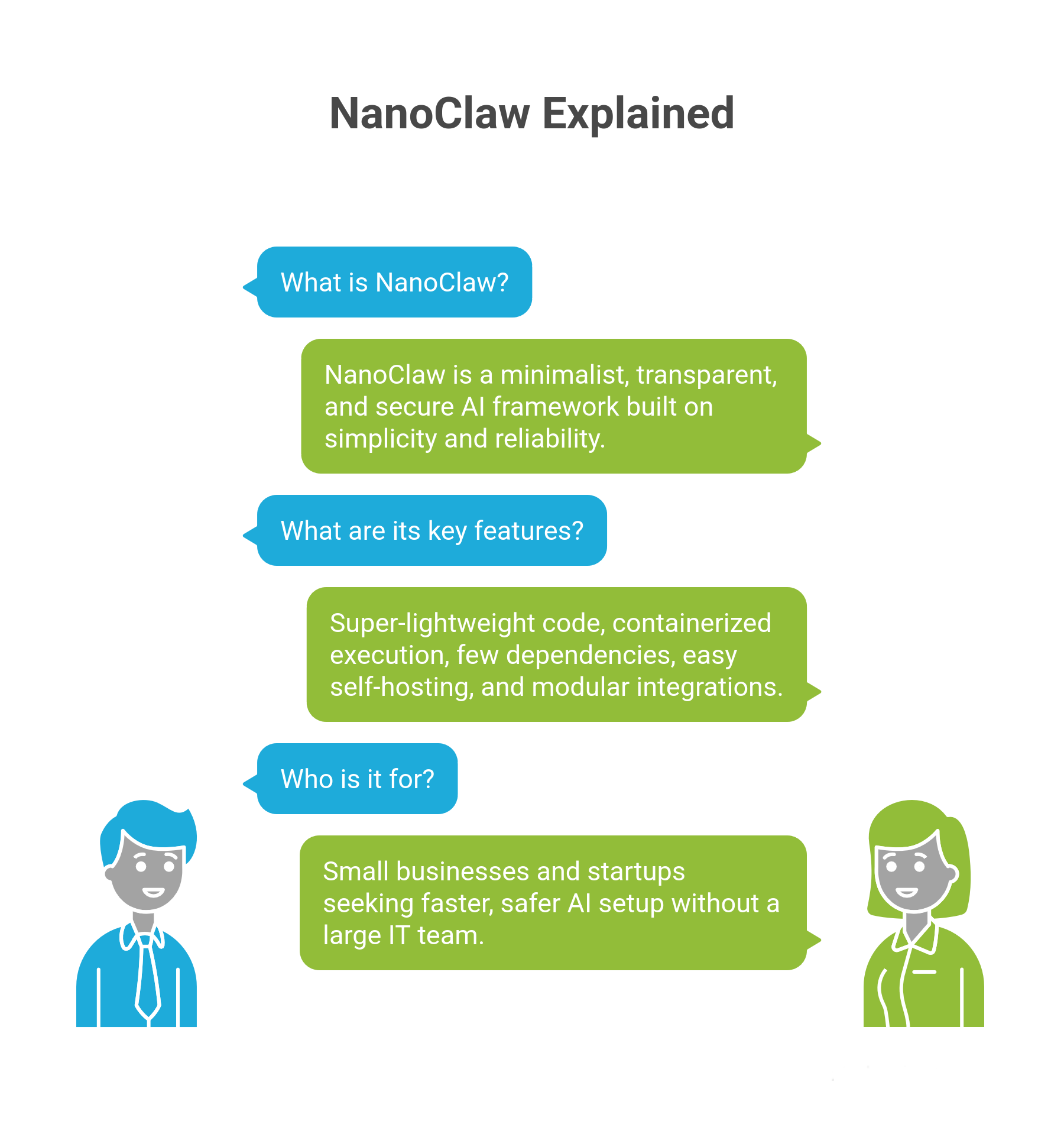
NanoClaw is built like a minimalist safe: small, transparent, and locked down tight. Its core idea? Keep things simple to make them reliable and secure.
Instead of a giant ecosystem, NanoClaw uses a tiny codebase (often just hundreds to a few thousand lines vs. OpenClaw’s massive size) and runs each agent in its own isolated container—like putting each worker in their own secure room so one can’t mess with the others.
Key features include:
- Super-lightweight and easy-to-read code (you can audit it quickly)
- Containerized execution (strong isolation via Docker or Apple Containers)
- Few dependencies (less to break or hack)
- Easy self-hosting on your own servers or even small devices
- Modular but focused integrations (e.g., WhatsApp, Telegram, scheduled tasks)
For small businesses or startups getting AI consulting, this simplicity means faster, safer setup without needing a huge IT team.
Did You Know:
Many cybersecurity experts recommend minimizing dependency chains in AI frameworks to reduce potential vulnerabilities.
NanoClaw vs OpenClaw: Architecture Comparison
Choosing between these is like deciding between a sprawling mansion (OpenClaw) and a secure, efficient modern apartment (NanoClaw). For AI automation consulting or AI deployment services, architecture affects everything from security to costs.
Codebase Complexity
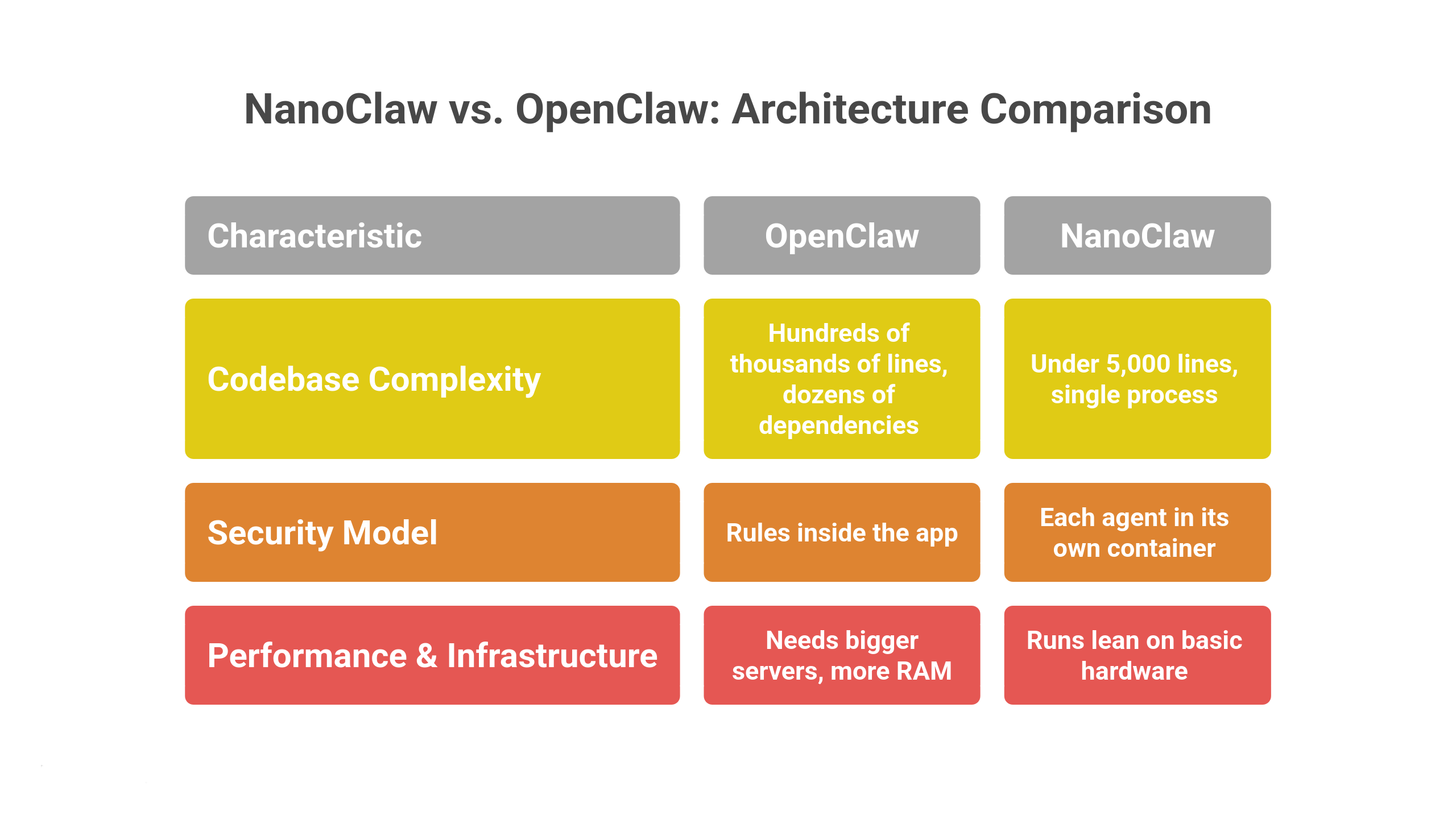
OpenClaw is like a big house with many rooms, extensions, and gadgets—great for advanced needs but hard to maintain and understand fully (hundreds of thousands of lines of code, dozens of dependencies).
NanoClaw is a clean, compact home—minimal code, limited extras, one straightforward setup (often under 5,000 lines, single process).
This smaller size cuts maintenance time and headaches for teams doing AI integration services.
Security Model
Here’s the big difference: OpenClaw uses rules inside the app (like locks on doors inside the house—application-level permissions and shared runtime).
NanoClaw locks things at the foundation—each agent in its own container with OS-level isolation (separate buildings on the property). If one agent has issues, it can’t spread to the host system or others.
This is huge for SMB AI automation —stronger protection against prompt injection or misbehavior.
Did You Know:
Prompt injection attacks remain one of the most common vulnerabilities affecting AI agents operating in multi-system environments.
Performance and Infrastructure Efficiency
OpenClaw needs more “fuel”—bigger servers, more RAM—for its plugins, dashboards, and services.
NanoClaw runs lean: deploy on a basic Linux server, Mac Mini, small cloud instance, Raspberry Pi, or even edge devices. Lower costs, easier management—like driving a fuel-efficient car vs. a gas-guzzling truck.
For AI automation for operations, this can slash infrastructure bills significantly.
Did You Know:
Lightweight AI agent frameworks can reduce infrastructure costs by up to 40 percent compared with large enterprise automation platforms.
When Businesses Should Choose NanoClaw
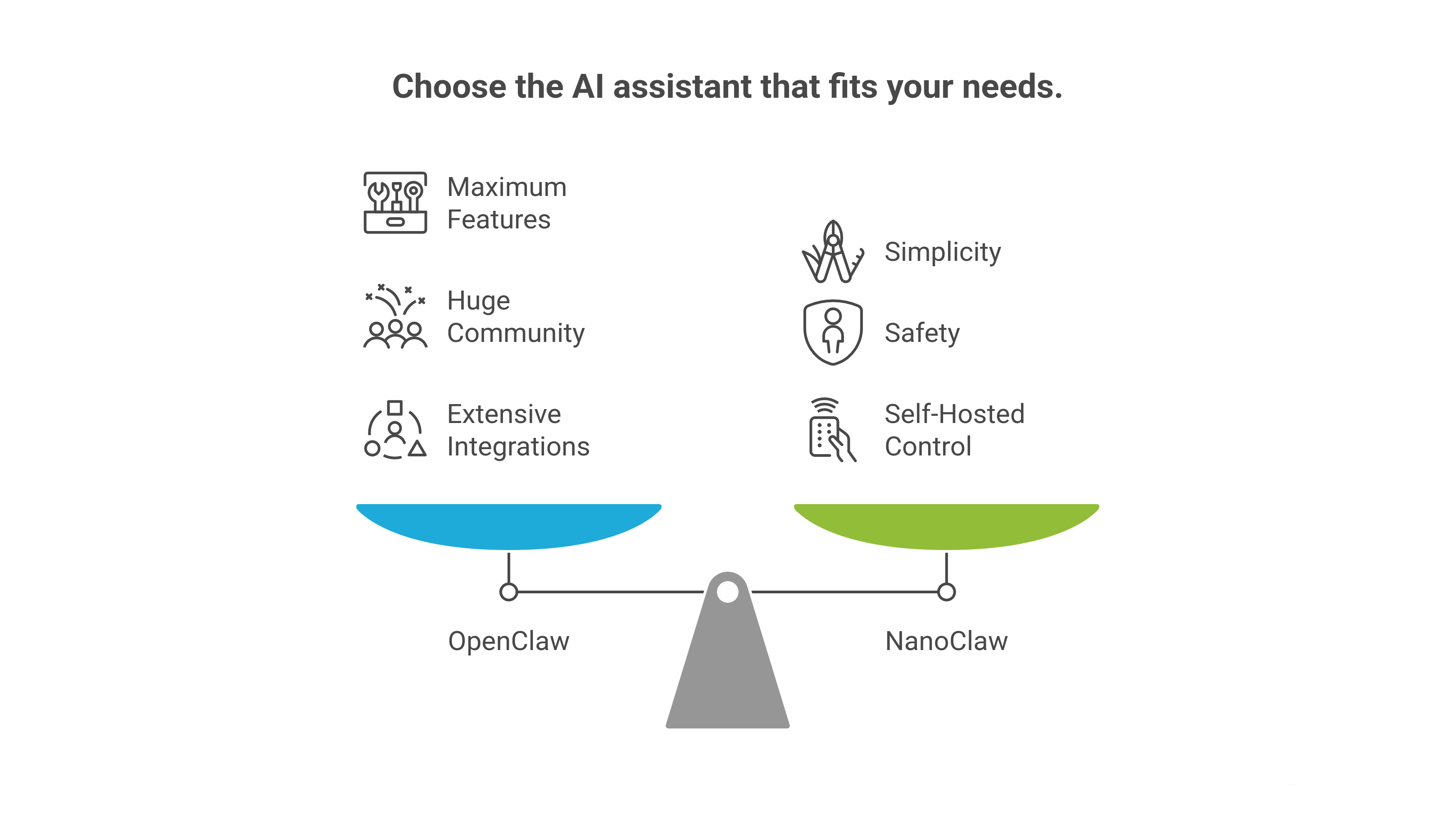
OpenClaw shines for teams wanting maximum features, a huge community, and extensive integrations.
But NanoClaw wins when you prioritize safety, simplicity, and quick wins—like a reliable daily driver over a sports car.
Choose NanoClaw if you need:
- Secure internal AI assistants
- Lightweight automation without complexity
- Self-hosted setups you fully control
- Custom automation without endless tweaks
It’s ideal for for small business or limited engineering resources.
Did You Know:
Research from McKinsey shows that companies implementing structured AI transformation strategies are more than twice as likely to achieve measurable ROI.
(Updated insight: Recent reports note rapid growth in agent adoption, with many organizations experimenting or scaling containerized, secure agents like those in the NanoClaw style.)
The Role of AI Business Consulting in AI Agent Adoption
This isn’t just a tech choice—it’s a business strategy affecting security, costs, and growth.
Many companies partner with AI business consulting firms to:
- Run AI readiness assessments
- Build AI transformation roadmaps
- Choose and deploy secure agent setups
- Integrate AI into workflows safely
With AI adoption accelerating, structured consulting helps avoid pitfalls and capture real value.
Did You Know:
More than 60 percent of companies implementing AI initiatives rely on consulting partners for deployment strategy and integration.
Frequently Asked Questions (FAQ) – NanoClaw vs OpenClaw
1. What is the main difference in NanoClaw vs OpenClaw?
In the NanoClaw vs OpenClaw comparison, the core difference is design philosophy. OpenClaw is like a massive toolbox packed with every possible tool—great for power users but complex and riskier. NanoClaw is a streamlined, secure toolkit: minimal code, containerized isolation, fewer dependencies, and built-in transparency for easier auditing and safer deployments.
2. Which is more secure in NanoClaw vs OpenClaw?
NanoClaw wins clearly in NanoClaw vs OpenClaw when it comes to security. NanoClaw enforces OS-level isolation with containers (each agent in its own secure “room”), limiting damage from prompt injection or misbehavior. OpenClaw relies on application-layer permissions in a shared environment, making it more vulnerable if not perfectly configured.
3. In NanoClaw vs OpenClaw, which is better for small businesses?
For most small businesses and startups, NanoClaw is the stronger pick in NanoClaw vs OpenClaw debates. It’s simpler to set up, runs on low-cost hardware (Mac Mini, small cloud instance, Raspberry Pi), has lower security risks, and requires less ongoing maintenance—perfect when engineering resources are limited.
4. Does NanoClaw vs OpenClaw show big cost savings?
Yes—NanoClaw often saves 30–40% on infrastructure in NanoClaw vs OpenClaw comparisons. Its lightweight architecture means less CPU, RAM, and cloud spend—no heavy dashboards, extra services, or plugin overhead. Businesses running lean AI automation love the lower monthly bills.
5. Can NanoClaw handle integrations in NanoClaw vs OpenClaw?
Absolutely. While OpenClaw has a huge plugin ecosystem, NanoClaw focuses on clean, modular integrations (WhatsApp, Telegram, APIs, scheduled tasks) without bloat. In NanoClaw vs OpenClaw, you get what you need securely—without the complexity of hundreds of extras.
6. Is NanoClaw easier to set up in NanoClaw vs OpenClaw?
Yes—NanoClaw is typically faster and simpler in NanoClaw vs OpenClaw setups. Its tiny, transparent codebase and container-based deployment mean you can audit and launch in hours, not weeks. OpenClaw’s larger ecosystem often requires more configuration and troubleshooting.
7. Should I switch from OpenClaw to NanoClaw based on NanoClaw vs OpenClaw?
If security, simplicity, or cost is a concern, many teams switch after comparing NanoClaw vs OpenClaw. NanoClaw reduces attack surfaces and maintenance headaches. If you heavily depend on OpenClaw’s vast plugins and haven’t had issues, you might stay—but lightweight, secure agents like NanoClaw are the future for most business use cases.
8. How does self-hosting compare in NanoClaw vs OpenClaw?
Both support self-hosting, but NanoClaw excels in NanoClaw vs OpenClaw for self-hosted setups. It runs efficiently on minimal hardware with strong built-in isolation, making it ideal for companies wanting full control without high resource demands.
9. Which framework has lower risk of prompt injection in NanoClaw vs OpenClaw?
NanoClaw has significantly lower risk in NanoClaw vs OpenClaw security discussions. Container isolation prevents compromised agents from accessing the host system or other agents. OpenClaw’s shared runtime makes prompt injection attacks harder to contain without perfect safeguards.
10. How do I choose between NanoClaw vs OpenClaw for my next AI project?
Use this quick NanoClaw vs OpenClaw decision guide:
- Need maximum plugins, community size, and advanced integrations? → OpenClaw
- Want top security, simplicity, low cost, easy self-hosting, and fast deployment? → NanoClaw
Many AI consulting firms including AI Software Systems now favor NanoClaw in NanoClaw vs OpenClaw evaluations for production business automation in 2025–2026.
Final Thoughts
NanoClaw vs OpenClaw shows the evolution of AI agents: from “bigger is better” to “smarter and safer is best.”
Early tools expanded fast; newer ones like NanoClaw focus on security, transparency, minimal risks, and container isolation—like shifting from a wild toolbox to a trusted, locked set of essentials.
For businesses pursuing AI transformation strategies through AI consultants, picking a secure foundation like NanoClaw will matter more than ever.
Next article on this subject coming soon!..
An Article by N Delgado 2026 | CMO | AI Software Systems | AI Consultants For Business