

OpenClaw Security Risks: Viral AI Agent or a Business Security Nightmare?

Introduction
The rapid rise of autonomous AI agents has created a new wave of innovation in AI automation for business, and one project stands at the center of that movement: OpenClaw. Developers, entrepreneurs, and tech enthusiasts are experimenting with this powerful open-source AI agent to automate tasks, execute commands, and streamline workflows.
However, alongside the excitement, serious concerns are emerging about OpenClaw security risks. Security researchers and cybersecurity experts have warned that tools like OpenClaw can create significant vulnerabilities if deployed without proper safeguards.
For small business owners exploring AI-powered business automation, understanding these risks is critical. OpenClaw can interact with local files, run system commands, access APIs, and communicate with online services. While those features enable powerful automation, they also dramatically expand the attack surface.
In this guide, we examine the most important OpenClaw security risks, why the tool went viral, and what businesses must do to use autonomous AI agents safely.
For a beginner-friendly overview, read our previous article: OpenClaw 101: What Is OpenClaw?
Why OpenClaw Became One of the Most Viral AI Agents
OpenClaw is an open-source autonomous AI agent designed to perform real-world tasks by interacting with software, files, and web services. Unlike traditional chatbots, OpenClaw can operate independently and execute complex actions.
Key capabilities include:
- Executing terminal commands
- Accessing local files and directories
- Connecting with messaging platforms
- Running automated workflows
- Installing third-party skills and plugins
These features make OpenClaw extremely attractive for businesses seeking AI agent business solutions and intelligent workflow automation.
The project exploded in popularity after developers demonstrated agents that could:
- manage support tickets automatically
- monitor analytics dashboards
- generate reports
- automate marketing tasks
- perform development operations
OpenClaw quickly gained massive traction in the open-source community, surpassing 100,000 GitHub stars, making it one of the fastest-growing AI automation tools ever released.
For companies looking into business AI solutions, the productivity potential is enormous.
But with that power comes significant security concerns.
Did You Know:
Industry analysts estimate the autonomous AI agent market could reach $47 billion by 2030, fueled by the demand for intelligent automation in business operations.
Understanding the Most Critical OpenClaw Security Risks
While OpenClaw enables advanced automation, its architecture introduces several security challenges. Because the agent operates directly on a user’s machine, it often has extensive system permissions.
This means the AI may be able to access:
- SSH credentials
- private documents
- browser sessions
- API keys
- internal business data
- connected applications
If exploited, the agent could potentially perform malicious actions without the user realizing it. These concerns are driving many organizations to seek AI business consultants before implementing autonomous agents.
Below are the most significant OpenClaw security risks businesses should understand.
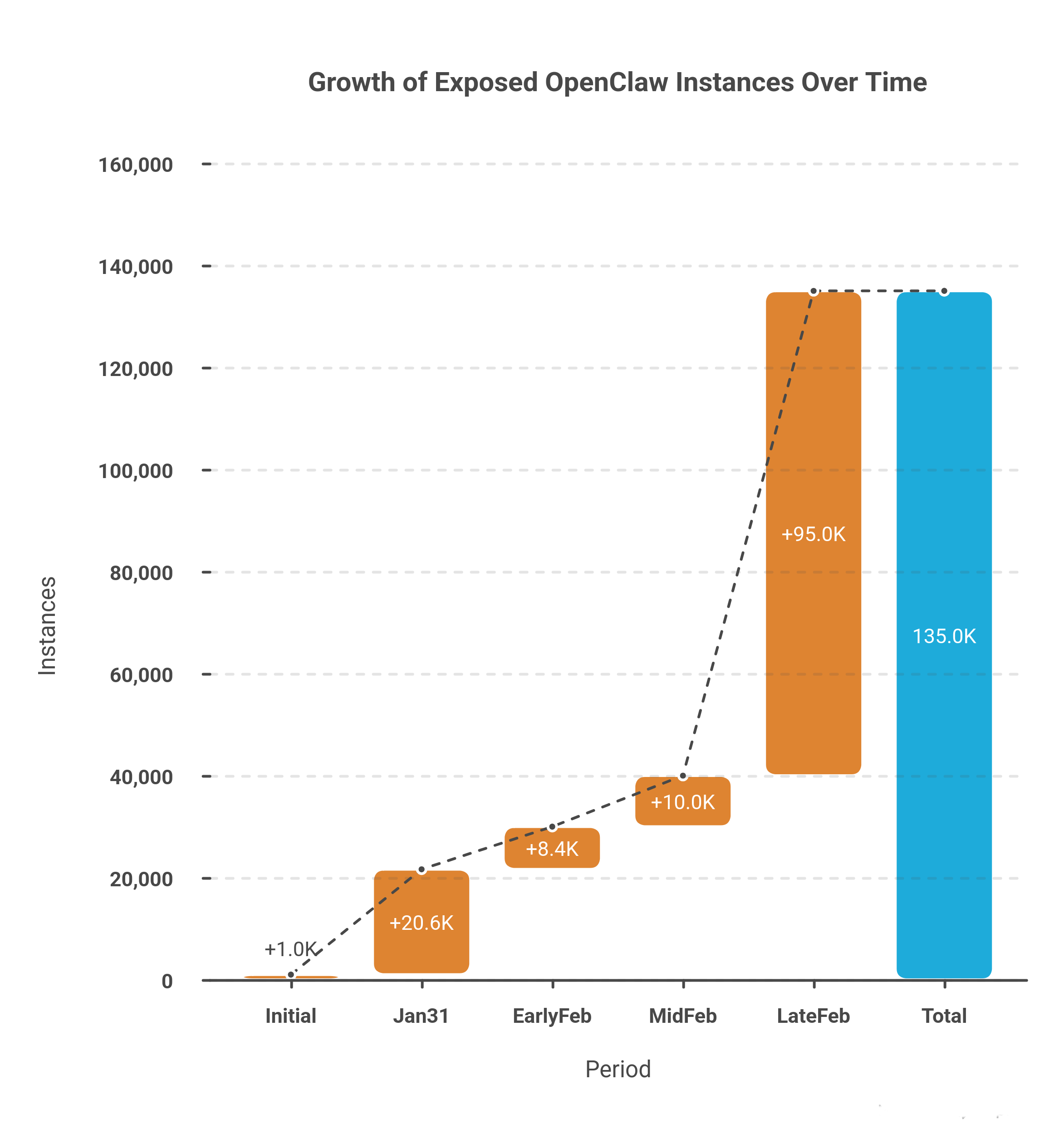
This data set focuses on the rapid increase in publicly exposed OpenClaw instances, highlighting credential exposure and API key risks (e.g., leaking Anthropic API keys, OAuth tokens, and plaintext credentials). It draws from scans by Bitsight, Censys, SecurityScorecard, and others, showing a spike from early January to mid-February 2026. Additional risks amplified here include browser-based attacks, as exposed instances often lack authentication, enabling remote exploits like CVE-2026-25253 (CVSS 8.8, one-click RCE via malicious links).
Did You Know:
Researchers have identified vulnerabilities across multiple OpenClaw components, including prompt processing, plugin systems, and external tool integrations.
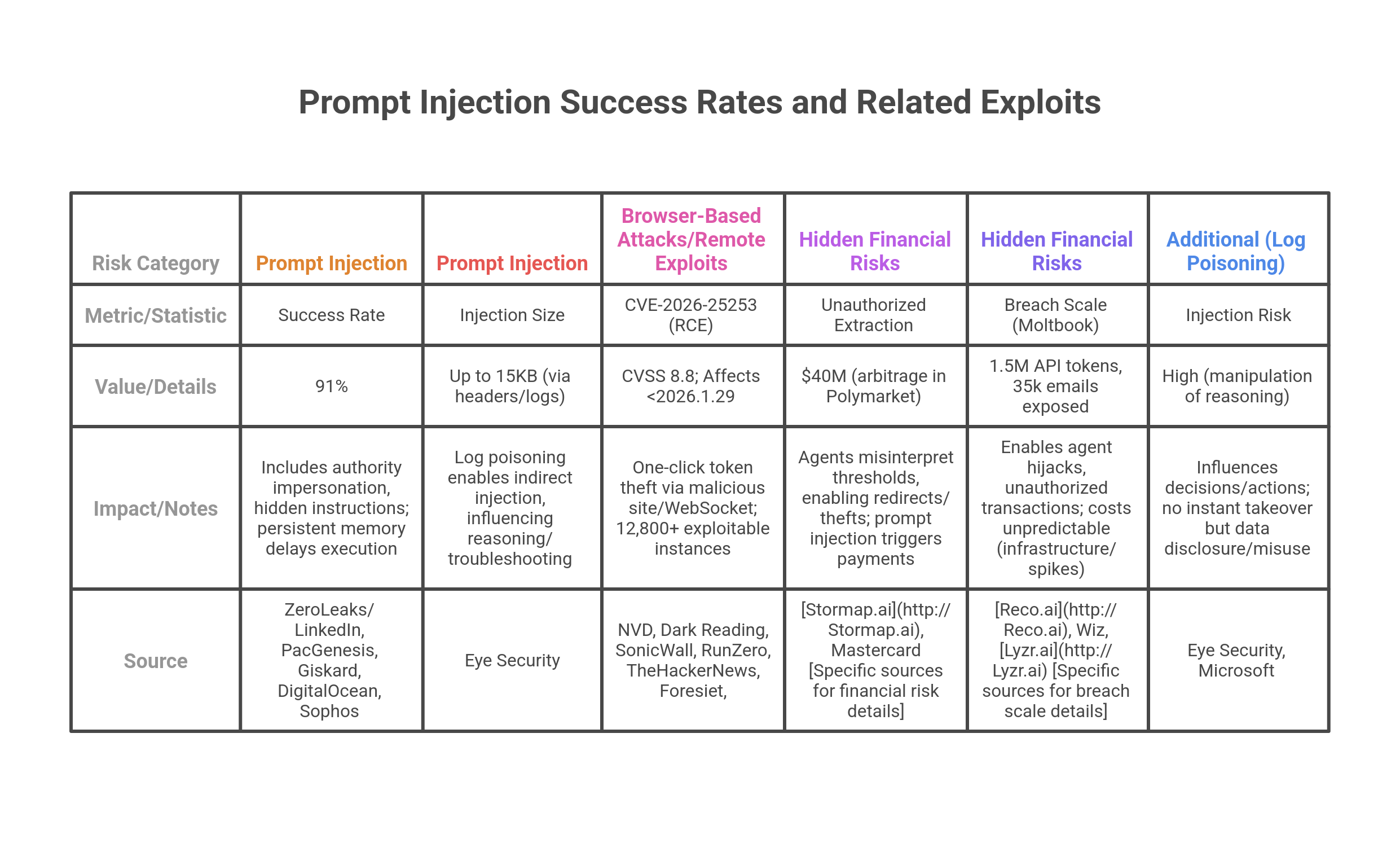
Prompt Injection: One of the Biggest OpenClaw Security Risks
Prompt injection attacks represent one of the most serious threats facing AI agents.
This attack occurs when malicious instructions are embedded inside content the AI reads. Because AI agents interpret text as instructions, hidden commands can manipulate the agent into performing unintended actions.
Attackers may hide malicious prompts inside:
- emails
- documents
- websites
- chat messages
- customer service tickets
For example, a webpage could contain hidden instructions telling the AI agent to retrieve confidential files and send them to an external server.
Because OpenClaw agents frequently interact with external data sources, prompt injection dramatically increases OpenClaw security risks.
Businesses implementing AI-driven business process automation consulting must therefore design strict guardrails for AI behavior.
Malicious Plugins and Third-Party Skills
Another major concern involves OpenClaw’s plugin ecosystem. The platform allows developers to create and distribute “skills” that extend the AI agent’s capabilities.
While this enables flexibility, it also introduces supply chain risks.
Security analysis of thousands of OpenClaw plugins revealed alarming statistics:
- More than 36% contained prompt injection vulnerabilities
- Over 1,400 plugins contained potentially malicious code
Malicious plugins could:
- install malware
- steal API credentials
- access local files
- open remote access channels
For companies using AI business automation tools, installing unverified plugins could expose their entire digital infrastructure.
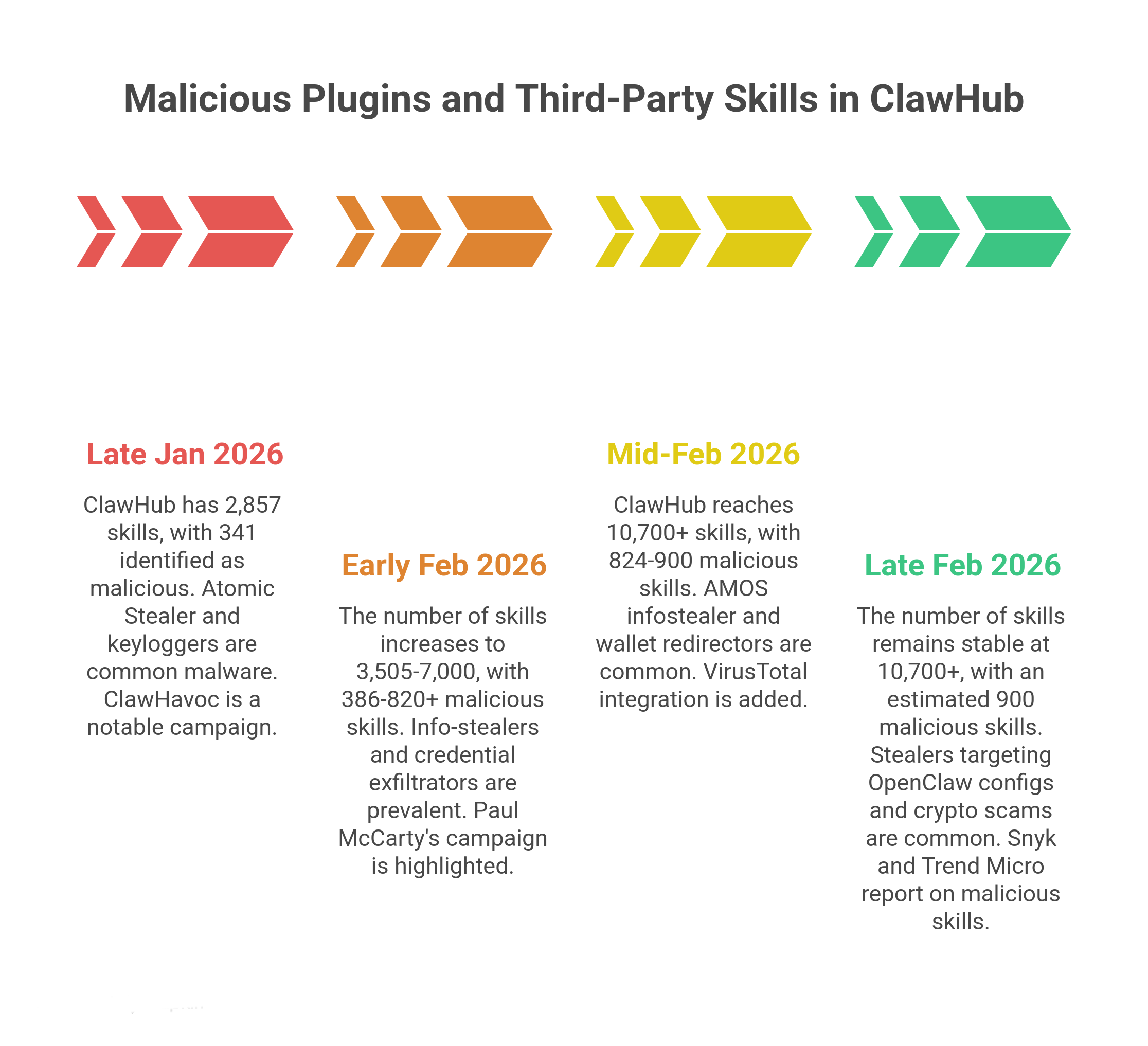
Clawhub = OpenClaw’s marketplace
Did You Know:
Software supply chain attacks increased by 742% between 2019 and 2023, making plugin ecosystems a major cybersecurity target.
Credential Exposure and API Key Risks
Another common issue related to OpenClaw security risks is how credentials are handled.
Many OpenClaw setups require users to configure API keys for services such as:
- OpenAI
- GitHub
- Stripe
- Google Cloud
- analytics platforms
Unfortunately, some configurations store these keys in plaintext files on the system.
If malware gains access to the machine, attackers can simply read these files and steal credentials. Once stolen, API keys can be used to:
- access databases
- trigger financial transactions
- extract sensitive data
- generate expensive AI API usage
Businesses deploying AI automation services for small to mid-sized business must implement proper credential management and encryption.
Browser-Based Attacks and Remote Exploits
Security researchers have also identified browser-based vulnerabilities affecting OpenClaw.
One exploit demonstrated how attackers could take control of an agent through its local WebSocket interface. If weak passwords were used, malicious websites could brute-force authentication and hijack the agent.
Once compromised, attackers could issue commands such as:
- deleting files
- executing scripts
- exporting data
- installing malware
This example highlights why OpenClaw security risks must be taken seriously when deploying autonomous agents.
Did You Know:
Cybercriminals have already distributed fake OpenClaw installers on GitHub designed to install credential-stealing malware.
Hidden Financial Risks of Autonomous AI Agents
Security is not the only concern associated with OpenClaw. Autonomous agents can also generate unexpected financial costs.
Because OpenClaw relies on external AI APIs, every action generates token usage. When agents run continuous tasks or enter loops, the cost can escalate rapidly.
In documented cases:
- users accumulated hundreds of dollars in a single day
- businesses experienced monthly AI bills exceeding $3,000
This is why companies increasingly rely on AI Consultants to design cost-controlled automation architectures.Proper guardrails, usage monitoring, and API limits are essential.
Did You Know:
Most AI agents send the full conversation history with every API request, which can significantly increase token usage and operational costs.
How Businesses Can Reduce OpenClaw Security Risks
Despite the challenges, AI agents remain one of the most transformative technologies for AI-powered business automation. With proper security controls, organizations can safely benefit from these tools.
Key security practices include:
Restrict Agent Permissions
AI agents should never run with full system access.
Best practice approaches include:
- containerized environments
- sandboxed execution
- limited file access permissions
Audit All Plugins
Before installing third-party skills:
- review the codebase
- verify the developer reputation
- scan for malicious scripts
Supply chain attacks often begin through compromised plugins.
Secure API Keys
Never store credentials in plaintext.
Instead use:
- encrypted secrets managers
- environment variables
- restricted API scopes
Monitor Agent Behavior
Businesses should implement monitoring systems that track:
- system commands executed
- network requests
- file access events
- API usage patterns
This makes it easier to detect abnormal activity.
Work With an AI Business Consulting Agency
Many organizations partner with a business process AI consulting firm to implement secure AI automation strategies.
Professional AI consulting services help businesses deploy:
- modular AI agents
- secure workflow automation
- permission-based access controls
- scalable automation infrastructure
These systems allow companies to benefit from automation while minimizing OpenClaw security risks.
Did You Know:
More than 60% of enterprise automation initiatives now involve AI-driven agents or intelligent workflow automation platforms.
How AI Agents Are Now Talking to Each Other
As a side tale and on one of the more interesting developments around OpenClaw and similar tools is that AI agents are starting to communicate with each other automatically—without any human involvement.
Projects like MoltBot show how multiple agents can work together as a small network. One agent might generate a task, send it to another agent, and that agent then processes the request and returns the result. This communication usually happens through shared APIs, messaging layers, or internal memory systems that allow agents to pass instructions back and forth.
For example, one agent might gather data, another might analyze it, and a third agent might generate a report. The entire workflow can run autonomously once the system is started.
You can see an example of this type of agent-to-agent communication here: Moltbook
While this kind of automation is powerful for AI automation for business, it also adds another layer to the OpenClaw security risks we discussed earlier. If one agent receives a malicious instruction or compromised plugin, it could potentially pass that instruction to other agents in the system.
That’s why businesses deploying AI agent business solutions should treat multi-agent systems carefully and ensure proper security controls, monitoring, and permission limits are in place.
FAQ About OpenClaw Security Risks
Are OpenClaw security risks serious for businesses?
Yes. Because OpenClaw agents can execute commands and access sensitive data, vulnerabilities may allow attackers to manipulate the system or extract information.
Can OpenClaw be used safely?
Yes, but only when implemented with proper safeguards such as restricted permissions, encrypted credentials, and secure plugin management.
Why are AI agents considered risky?
AI agents perform real-world actions rather than just generating text. If compromised, they can execute harmful commands automatically.
Should small businesses avoid OpenClaw entirely?
Not necessarily. With proper advice from a reputable AI consulting firm, companies can deploy AI agents safely while benefiting from automation and efficiency gains.
Final Thoughts
OpenClaw demonstrates both the incredible potential and the significant challenges of autonomous AI agents.
While the technology can dramatically improve efficiency, automate workflows, and unlock new capabilities for business, the security risks associated with OpenClaw must not be ignored.
Businesses that adopt AI agents responsibly—using secure architectures, strong credential management, and proper monitoring—will be best positioned to benefit from the next generation of intelligent automation.
The future of automation belongs to organizations that combine innovation with strong cybersecurity practices.
Related Articles:
NanoClaw vs OpenClaw: The Secure, Lightweight AI Agent Alternative
An Article by N Delgado 2026 | CMO | AI Software Systems | AI Consultants For Business